9/8/2026 Meeting Preview
UPDATE (12:15 pm, 9/8/2026): The City Manager responded to some of my inquiries that are referenced below. You can see his responses here.
You’ll see below some of the agenda highlights for our first meeting in September.
I’ve added information from the council agenda memos and background on items that may be of particular interest, along with my thoughts on those issues. You can watch our meetings on the City’s Facebook and YouTube pages. Our meetings are typically on the first and third Mondays of the month, but we’re meeting on Tuesday this week because of the Labor Day holiday. Workshop Session begins at 6:00 pm; Regular Session begins at 7:30 pm; Executive Session, if necessary, takes place at the conclusion of the Regular Session.
You can access the full agenda packets here.
We welcome your attendance at our meetings, and public comment is available near the start of the meeting, before any actions are taken. You can speak at the meeting by signing up for public comment here, starting at 4:00 pm on the day of the meeting, or by signing up in person at City Hall starting at 4:00 pm. If you have feedback for Mayor and Council directly, you can email us.
In my preview of the November 17, 2025 meeting, I raised my concerns about the adoption of a new public comment policy that eliminated the ability for comments to be emailed and read into the record. This change was placed on the agenda the day before the meeting, leaving little opportunity for the public to weigh in on a significant shift in how we engage with our stakeholders. I continue to disagree with this decision. I cannot support initiatives that make it more difficult for people to have their voices heard.
A note on Community Enhancement Funds:
In FY 2026–27, each member of the governing body has been allocated $400,000 in community enhancement funds: the funds are evenly split between capital projects ($200,000) and non-capital expenditures ($200,000). Each elected official also has $100,000 for City Wide Events, for a total of $500,000.
Unlike the formal budgeting process undertaken by staff, where every dollar is tied to a specific line item, my colleagues and I did not go through that level of detail when these enhancement funds were allocated. As a result, some of the items being funded through these accounts are appearing for the first time on the consent agenda without any prior public discussion.
To ensure you have a real opportunity to weigh in on how these public funds are used (especially given the recent changes to the public comment policy), I believe any community enhancement expenditure not specifically identified in the adopted budget should appear in the Regular Business section of the agenda, not the Consent Agenda.
I will continue to provide updates detailing how your dollars are being spent. You deserve to know where and how your tax dollars are being invested.
To see the latest spending information, visit How the Math is Mathing: An Ongoing Series.
Regular Session, 7:30 p.m.
7. Public Hearing
A. Public hearing and action on a request to approve a resolution for a conditional height permit at 3636 College Street and 0 College Street (14 006100160123 and 14 016100160081) for a multifamily residential development.
The city planner has recommended approval of this conditional height permit. Typically, such a request would go before the planning commission. However last year, the Council approved a process that would bypass that group for land owned by BIDA or the City, making it purely administrative. I do not think this decision was one made for efficiency’s sake, but rather one with this project and perhaps others in mind, limiting the potential for opposition.
There has been little to no public support for this project of which I am aware. Replacing green space (Bill Evans baseball field and the practice field at Badgett Stadium) with 261 upscale multifamily units was not a change that residents championed, especially considering the plethora of land available in Six West.
I believe this project will negatively change the character of the neighborhood and reduce access to recreational opportunities for our community. For those reasons and several more, I am not in support of it. I encourage you to come and share your thoughts about the request at the public hearing.
B. Public Hearing for INSPIRE Placemaking Collective to give an update on the Comprehensive Plan Draft.
This is your last chance to provide input for the document that will shape our decision-making for the next five years and beyond. Please come and make sure your voice is heard.
8. Consent Agenda
As I’ve noted before, according to the Georgia Municipal Association’s Handbook for Mayors and Councilmembers, “a consent agenda can be a useful tool when a governing body has a lot of business to cover. It typically includes noncontroversial items or those previously discussed and needing final approval, such as permit issuances, street closures, or bill authorizations. While a consent agenda can save time, it should never be used to bypass public participation or stifle open dialogue.”
E. Consideration of and action on a request to approve additional funding for Kanoom Construction for the ongoing renovation of the historic Conservatory House located at 4320 Herschel Road at the Regional Botanical Garden in the amount of $200,000 G/L Account #275 4975 54 7655 Tourist Product Development (TPD).
The packet does not state how much the City has already spent on this project. That number is important because under OCGA § 36-91-22(a), Georgia's public works bidding requirements attach to local projects costing $250,000 or more, and the statute says projects shall not be subdivided to evade those requirements. This request is $200,000, which leaves $50,000 of room before the threshold. I have asked the City Manager how much has been spent on this project to date, and whether the project has to go out to bid if this addition puts it over $250,000. I will keep you apprised if I receive a response.
9. Regular Business
A. Consideration of and action on a request to approve Mayoral Legislative Aide Contract in the amount of $6,066.66 per month. This is a budgeted item FY 2027 G/L Account #100 1300 52 6170, Contractual Services.
Councilmember Gay agreed to sponsor this agenda item. When the agenda was published, Councilmember McKenzie was listed as the sponsor. I brought this up to the clerk and she informed me there had been a change. I don’t have any clarity about the switch and I am also unclear about why this was not placed on the consent agenda, as this is a budgeted item and every other legislative aide contract for my colleagues has been placed on the consent agenda. Even at our last meeting, when the Ward 1 legislative aide position was changed to a chief of staff position, it was addressed via the consent agenda.
There has been some misinformation surrounding the previous legislative aides who were supporting me. Our previous city manager, Lindell Miller, approved the addition of a subcontractor at no additional cost to the city. Gaining approval from the city manager was the appropriate method pursuant to the contract. When our current city manager came into the role, he was brought up to speed, the subcontractor was onboarded through human resources, and she got to work. Several months later they were both abruptly terminated by the city manager. He did not discuss the decision to terminate my legislative aides prior to sending them each an e-mail; I was copied on the correspondence.
E. Consideration and Action on Trane U.S. Inc. Cooperative Agreement under OMNIA Contract #3341 and Payment for City Hall HVAC Services in the amount of $446,705.31.
The packet states the work has already been completed, and it was necessary. City Hall has had repeated cooling failures, the equipment is past its service life, and the people who work in the building and the people who go there to do business deserve a properly functioning facility. I do have questions about how we got here, though.
I have asked the City Manager when Council provided approval to proceed, given that the work is finished and the payment is only now coming to us. I have also asked whether this work is an exception to Georgia's public works bidding statute, and if so, on what basis. That statute requires local governments to award public works construction contracts of $250,000 or more by competitive sealed bidding or competitive sealed proposals, and the exceptions listed in OCGA § 36-91-22 do not include cooperative purchasing agreements. This warrants further discussion and I will let you know if I receive a response to my questions from the City Manager.
H. Consideration and Action on a Resolution Adopting the City of College Park Elected Official Security Policy.
One doesn’t have to look terribly hard to find instances of elected officials across the country being threatened and harassed for the decisions they have made. It is unacceptable and should not be tolerated in any shape or form.
As Americans, we also have the right to speak freely when we disagree with our leaders, and peacefully protest to make our feelings known.
I have seen my neighbors doing far more of the latter, not the former. I also find it completely appalling that members of our community were specifically named in the packet while exercising their constitutional rights. The description of their actions does not, in my opinion, rise to a credible threat, even as defined by this policy. But naming private citizens who exercised assembly rights in a document supporting a security request could serve to chill public participation moving forward.
The policy itself gets this part right. It states that mere criticism, political disagreement, public comment, and other constitutionally protected speech, standing alone, do not constitute a credible threat. Residents should never have to wonder whether disagreeing with an elected official at a public meeting will be treated as a threat.
I also question some of the rationale for this policy. I’m not certain how security protection for elected officials would have prevented city documents from being disposed of in a recycling dumpster. And while I am aware of a situation involving nails in the parking spaces at City Hall in April 2022, I have not been informed of any similar incident since.
Protecting the individuals in leadership from credible threats is not only reasonable, it is the right thing to do. We have to balance that against our obligation to spend public money transparently and to keep the public's business in public view. I have some questions about how that will proceed with this policy and I have put them to the City Manager.
First, the agenda memo states this is not a budgeted item and that funding options will be discussed at the meeting. I have asked what the proposed funding source is and what the estimated annual cost will be. The policy sets no dollar limit, per incident or per year.
Second, the policy authorizes the purchase of security equipment and security assessments at private residences. I have asked who owns equipment purchased with public funds, how it is inventoried, and what happens to it when an official leaves office. Public money buys public property, period.
Third, the policy says Council will consider individual requests in accordance with Georgia law on public meetings and executive sessions. I have asked for confirmation that Council's approval of any individual request will be voted on in open session. Under Georgia law, discussion of a security plan may be closed, but every vote must be taken in public. The policy should say that plainly.
A spending cap, clear rules on equipment, an annual public disclosure of what was spent, and an explicit commitment that approvals happen in open session would strengthen this policy without weakening a single protection it offers.
I. Consideration and Approval of Destination Marketing Organization Services Agreement with Destination Must Visit Tourism Alliance, Inc.
This agreement directs our new DMO to spend restricted hotel-motel tax dollars on purposes Georgia law does not permit. Then, in a separate section, it tells the DMO to comply with Georgia law. Both of those things are in the same document. That is not a safeguard. That is a way of passing a problem downstream and hoping someone else catches it.
College Park levies an eight percent hotel-motel excise tax. Georgia law does not let a city spend that money however it likes. It divides the revenue into certain categories, and those categories have rules.
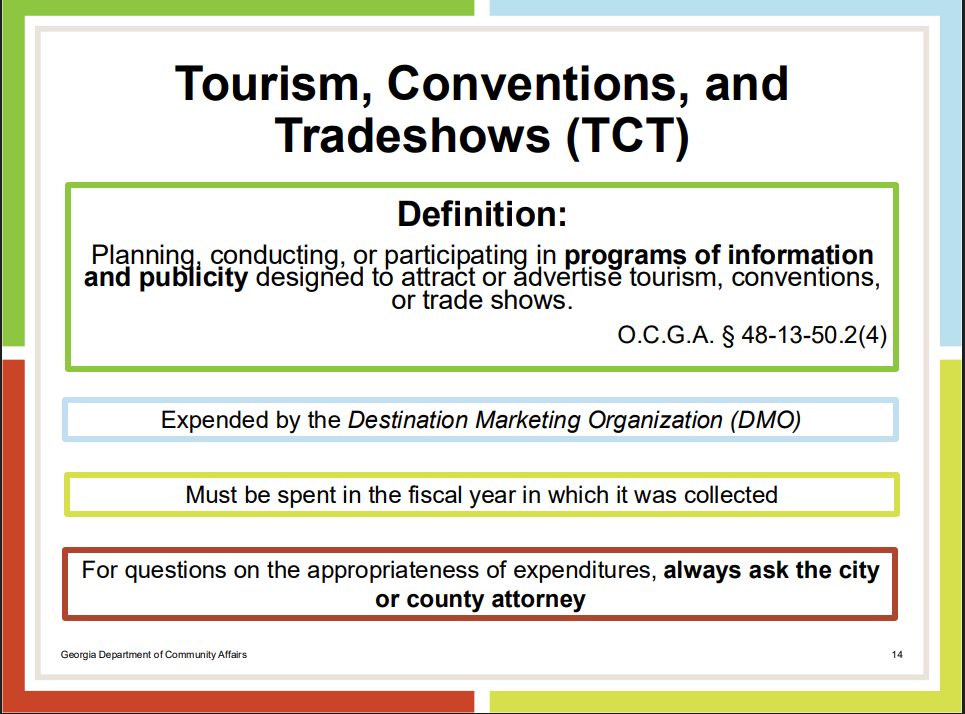
One of the categories is Tourism, Conventions, and Trade Shows, or TCT. State law defines it narrowly. Under O.C.G.A. § 48-13-50.2(4), TCT means “planning, conducting, or participating in programs of information and publicity designed to attract or advertise tourism, conventions, or trade shows.” It is advertising and recruitment. TCT money must be spent through a contracted destination marketing organization.
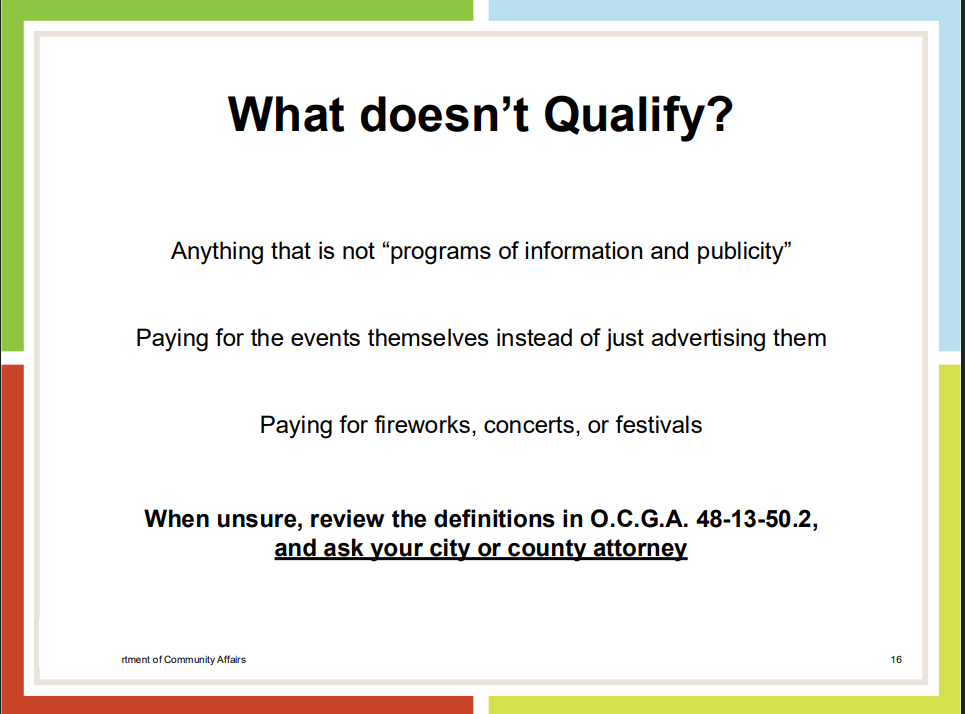
The Department of Community Affairs publishes guidance on this, and it is not ambiguous. One of DCA's slides is titled "What doesn't Qualify?" The answers listed are paying for fireworks, concerts, or festivals, paying for the events themselves instead of just advertising them, and anything that is not programs of information and publicity.
A second category is Tourism Product Development, or TPD. Under O.C.G.A. § 48-13-50.2(6), TPD means the creation or expansion of physical attractions which are available and open to the public, improve destination appeal to visitors, support the visitor experience, and are used by visitors.
Resolution 2026-18 is attached to the contract as Exhibit 5. It was adopted in June. Section 2 declares the City's intent that tourism-promotion funds recovered from our former DMO be distributed through the successor organization as follows:
Approximately $2,000,000 for the Roderick Gay Botanical Garden Conservancy and related botanical garden initiatives
Approximately $1,000,000 for the CP Historical Preservation Conservancy and related heritage tourism and historic preservation initiatives
Approximately $1,000,000 for the Georgia International Convention Center
Approximately $1,000,000 for City-sponsored festivals, cultural events, entertainment programming, and tourism-related special events
Approximately $1,000,000 for destination marketing services, visitor attraction initiatives, convention recruitment, and startup activities of the successor DMO
The remaining balance for other lawful purposes
The contract does not treat this as guidance. Exhibit 2 states that the DMO shall disburse funds in accordance with Resolution No. 2026-18, and that this is an annual funding disbursement requirement in perpetuity of the term of the agreement. The term, with renewals, runs through June 30, 2030. The agreement also carries an effective date of July 1, 2026, which is more than two months ago.
However, any funds recovered from the ATL Airport District are restricted TCT funds. They were paid out to satisfy the City's tourism promotion obligation, and we reported them to the state that way. Getting them back does not convert them into something else.
Measured against the definition of TCT, the festivals and events line does not qualify. One million dollars for City-sponsored festivals, cultural events, and entertainment programming is paying for events. DCA's guidance addresses this directly and says no. We cannot use TCT funds to construct a museum, visitor center or other attraction. We cannot use them for routine operations of a facility. We cannot use them for capital improvement or renovations to a physical attraction, nor can we use them to acquire land or buildings. Passing them on to another organization, such as a conservancy, for any of those purposes, would also be prohibited.
There is another noteworthy provision. Exhibit 1 of the agreement, item 11, entitles the DMO to an administrative fee equal to fifteen percent of any tourism product development funds it administers. The City does not need a DMO to spend TPD money in the first place, so this is fifteen percent for a service state law does not require.
Additionally, Section 7 of the agreement says that if any provision conflicts with the mandatory requirements of state law, applicable law shall control. Exhibit 1 says something similar.
I understand why that language is in there, because it attempts to protect the City from entering into a contract that is unlawful on its face. But it does not tell anyone which of the six allocations survive, it does not tell our new DMO what to do when the resolution and the statute point in different directions, and it does not stop a check from being written.
If we know an allocation is not permitted, the right answer is to not put it in the contract. Writing it in and then adding a clause that says follow the law anyway is a copout.
There is also this glaring issue: none of this money is designated to the actual work of filling hotel rooms.
A destination marketing organization earns its keep by competing for business. That means going after conventions, meetings, sporting events, and group tours, and offering the kind of support that convinces an organizer to choose us over somewhere else. The ATL Airport District has done that for us for over a decade. Recruiting business to the GICC and the Gateway Arena and putting heads in beds in the airport corridor is the core of what they have done with TCT funds. Now we are proposing to spend tourism promotion money on almost everything except tourism promotion.
But this is not the first time we have been challenged on our use of hotel-motel taxes.
In 2013, the Department of Community Affairs conducted a complaint investigation into College Park's hotel-motel tax expenditures. During that inquiry, DCA made a number of findings that matter as we address our current situation.
The City had been funding the Georgia International Convention Center out of restricted hotel-motel tax collections. DCA determined that the current GICC, which opened in 2003, did not meet any of the four statutory criteria to be an eligible facility. The prior convention center, which opened in 1985, was eligible. The new one that replaced it was not, and DCA found no provision in the law allowing support of a new facility that replaces a former eligible facility. The recommended corrective action was that the City immediately discontinue all support funding to the GICC from restricted hotel tax collections other than allowable TPD funding.
The City had also been expending restricted funds through an entity called the College Park Destination Marketing Organization, Inc. DCA found it was created by resolution of the Mayor and City Council, that its articles of incorporation identified the Mayor as incorporator using the City's official address, and that a majority of its board were city employees or city appointees. DCA concluded it was not a private sector entity, did not meet the statutory definition of a destination marketing organization, and was therefore not an eligible contractor through which restricted funds could be spent. The recommended corrective action was to cease immediately and contract with an entity that met the definition.
Another important point in the DCA report was the recounting of a February 4, 2009 special called council meeting. The City Attorney at the time explained that while the City’s prior convention center qualified for use of TCT funds, the new one was not exactly defined in the code section, and that it was his opinion the replacement facility counted. Then he said that while he was comfortable with that interpretation, it was not ironclad. Councilmember Ambrose Clay then asked what could happen if it was not ironclad. The City Attorney’s answer was that someone could tie the City up in court litigating whether the tax itself was valid.
That was seventeen years ago. The City proceeded on an interpretation it knew was not ironclad. Four years later the state told us we had been wrong, and the City had to face the consequences of the misuse of over $8 million in hotel-motel tax revenue. I would rather deal with the issues surrounding the pending DMO contract before we enter into an agreement than explain them afterward. We did it the other way in 2009. I was not on the Council then, but I have read what it cost us, and I am not interested in doing it again.
Regardless of Tuesday night’s vote, we have a hearing with the Hotel Motel Tax Performance Review Board on November 2 at 10:00 am at the Georgia Department of Community Affairs Office, Board Room 302, 60 Executive Park S, Atlanta, GA 30329. The proceeding is open to the public.