9/21/2026 Meeting Preview
You’ll see below some of the agenda highlights for our second meeting in September.
I’ve added information from the council agenda memos and background on items that may be of particular interest, along with my thoughts on those issues. You can watch our meetings on the City’s Facebook and YouTube pages. Our meetings are typically on the first and third Mondays of the month. Workshop Session begins at 6:00 pm; Regular Session begins at 7:30 pm; Executive Session, if necessary, takes place at the conclusion of the Regular Session.
You can access the full agenda packets here.
We welcome your attendance at our meetings, and public comment is available near the start of the meeting, before any actions are taken. You can speak at the meeting by signing up for public comment here, starting at 4:00 pm on the day of the meeting, or by signing up in person at City Hall starting at 4:00 pm. If you have feedback for Mayor and Council directly, you can email us.
Last year, I raised concerns about the adoption of a new public comment policy that eliminated the ability for comments to be emailed and read into the record. This change was placed on the agenda the day before the meeting, leaving little opportunity for the public to weigh in on a significant shift in how we engage with our stakeholders. I continue to disagree with this decision. I cannot support initiatives that make it more difficult for people to have their voices heard.
A note on Community Enhancement Funds:
In FY 2026–27, each member of the governing body has been allocated $400,000 in community enhancement funds: the funds are evenly split between capital projects ($200,000) and non-capital expenditures ($200,000). Each elected official also has $100,000 for City Wide Events, for a total of $500,000.
Unlike the formal budgeting process undertaken by staff, where every dollar is tied to a specific line item, my colleagues and I did not go through that level of detail when these enhancement funds were allocated. As a result, some of the items being funded through these accounts are appearing for the first time on the consent agenda without any prior public discussion.
To ensure you have a real opportunity to weigh in on how these public funds are used (especially given the recent changes to the public comment policy), I believe any community enhancement expenditure not specifically identified in the adopted budget should appear in the Regular Business section of the agenda, not the Consent Agenda.
I will continue to provide updates detailing how your dollars are being spent. You deserve to know where and how your tax dollars are being invested.
To see the latest spending information, visit How the Math is Mathing: An Ongoing Series.
Workshop Session, 6:00 p.m.
B. Discussion on the 130th City of College Park Birthday.
I think the City should mark this occasion, but I do not think it takes $200,000 to do it. We have limited resources. I think we can celebrate our past while being mindful of our roles as fiscal stewards.
The presentation proposes a budget of $200,000, split between a $100,000 request for City funding and a $100,000 corporate sponsorship target. The clerk’s office budgeted $5,000 for the 130th anniversary celebration. We need to figure out where the remaining $95,000 is going to come from. While the City's $100,000 is a fixed amount, the other $100,000 from corporate donors is a target. I am unclear what will happen if that goal is not met. The packet does not say whether the programming shrinks or the City would cover the gap. The proposal indicates four areas of spending. The largest share, 35 percent, or $70,000, would be used for a gala at the GICC.
2026 is also the 30th anniversary of the listing of the College Park Historic District on the National Register of Historic Places. The nomination packet documents 853 contributing resources across roughly 605 acres (about a quarter of the city) and includes a narrative history reviewed by the state Historic Preservation Division. It names our architects, our schools, our parks, and our monuments. We have an opportunity to celebrate this milestone as well, and I hope we will do so.
Regular Session, 7:30 p.m.
9. Consent Agenda
A. Consideration of and action on a request on the replacement of GICC Chiller No. 1 by Maxair Mechanical, LLC in an amount not to exceed $867,563.00.
This is the largest expenditure on Monday’s agenda and certainly needed for the convention center. However, I do have questions about the process, and I have reached out to the city manager for answers. I’ll let you know if I get more information.
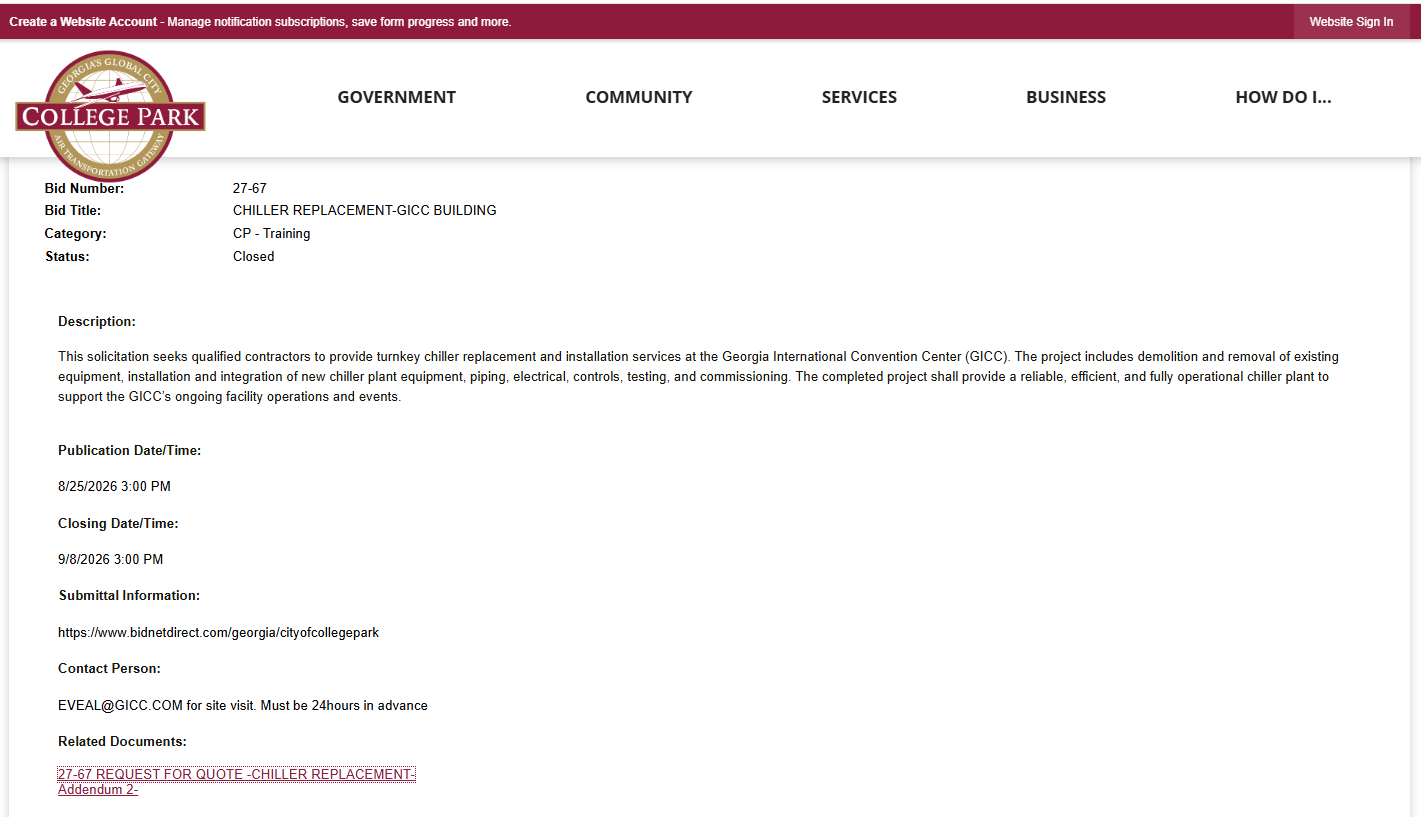
The City's bid posting for RFQ No. 27-67, Chiller Replacement - GICC Building, listed a publication date of August 25, 2026 at 3:00 PM and a closing date of September 8, 2026 at 3:00 PM.
The procurement justification memo from the GICC’s executive director, dated August 5, 2026, states MaxAir Mechanical was selected as the lowest bidder at $867,563.00. Our procurement manager signed the memo on August 6, 2026; the city manager signed it on August 17, 2026. All of those dates were before the City published the solicitation.
Additionally, the RFQ document set the submission deadline as Tuesday, September 1, 2026, at 3:00 p.m. The bid posting online listed the deadline as September 8, 2026, at 3:00 p.m.
While the Council Agenda Memo states three vendors submitted responses, the justification memo indicated MaxAir and four others submitted bids, which would indicate five companies responded. Neither document names the other respondents or lists their prices.
It is imperative we get clarity on these matters before a vote is taken.
UPDATE (1:30 pm, 9/21/2026): The city manager responded and I asked additional questions. You can see the e-mail here.
E. Consideration of and action on a request to approve the adoption of the Project Torchlight Program in the amount of $50,000 in Ward 3.
This is a community enhancement expenditure that was not specifically identified in the adopted budget, which is precisely the kind of item I believe belongs in Regular Business rather than on the Consent Agenda.
The professional services agreement in the packet states a total fee of $10,000, paid in monthly installments, which leaves a $40,000 difference between the request and the contract. The agreement also states that it terminates on March 12, 2026, a date that has already passed.
Project Torchlight has been doing work in Ward 1 since earlier this year. In February, the organization was paid $9,500.00. In May, the City paid the remainder of that invoice, $500.00. In June, they received another $20,000, and in July, they were paid the remaining $4,999.00 from the invoice submitted the month prior.
As a general practice, before the City funds any youth program, the agreement should include a curriculum description, a nondiscrimination clause, and an assurance that no City funds support religious instruction.
UPDATE (1:30 pm, 9/21/2026): I received an additional invoice for the program this morning. You can view it here.
10. Regular Business
B. Consideration of and action to approve the Commercial Fleet Vehicles Ordinance.
The issue of autonomous vehicles staging in areas around the city, Zupp Park in particular, is one that has developed over the past several months. The vehicles have created public safety concerns among neighbors. This ordinance would prohibit commercial fleet staging on residential streets and in designated community areas. Staging means parking, queuing, waiting, or idling while a vehicle awaits a future trip.
As I’ve said in the past, since this is a change to the laws of our City, I think we should adopt a first and second reading policy to ensure we are not making changes on the dais that the public has not had an opportunity to review or voice an opinion about.
C. Consideration of and action to approve a Resolution for the establishment of a 9:30 p.m. End Time for Regular Business and Three-Minute Comment Limit Per Elected Official.
The agenda describes this as a resolution, but the attached document is an ordinance amending Chapter 2 of our Code. This is another change to our laws. As such, I think this should have a first and second reading.
Under this ordinance, regular meetings would adjourn no later than 9:30 p.m., and anything left on the agenda would carry forward automatically. Extension past 9:30 would require a unanimous vote of the members present, which means any single member could end the meeting. The city manager would be authorized to place carried-forward items under a new agenda section called "Old Business," and to designate items for the consent agenda. That subsection lists categories of routine matters, and it also allows any item previously discussed at a work session to go on consent. Each council member would be limited to three minutes of remarks per agenda item, not transferable and not aggregated, and the city manager or city clerk would monitor and enforce that limit and notify a member when time has expired. Closing remarks by the Mayor and each council member would be capped at three minutes each.
I support meetings that run efficiently. If there are issues that require our attention, though, we should address them. At our last meeting, we spent roughly 40 minutes on proclamations. One approach could be moving proclamations to the Workshop Session, where we could still recognize members of our community properly, and reclaim time in the Regular Session for the work in front of us. Additionally, it is the job of the presiding officer, typically the mayor, to run the meeting. Keeping time is a clerical task. Enforcing a limit against an elected official is not, and it belongs with the chair.
I also question whether this would hold in practice. The ordinance directs the city manager or city clerk to notify a member when time has expired, but it says nothing about what happens after that notification. A rule that is enforced some nights and not others is not a rule. It is a tool. I would rather we set expectations we intend to keep every time, applied the same way to every member.