8/17/2026 Meeting Preview
You’ll see below some of the agenda highlights for our second meeting in August.
I’ve added information from the council agenda memos and background on items that may be of particular interest, along with my thoughts on those issues. You can watch our meetings on the City’s Facebook and YouTube pages. Our meetings are typically on the first and third Mondays of the month. Workshop Session begins at 6:00 pm; Regular Session begins at 7:30 pm; Executive Session, if necessary, takes place at the conclusion of the Regular Session.
You can access the full agenda packets here.
We welcome your attendance at our meetings, and public comment is available near the start of the meeting, before any actions are taken. You can speak at the meeting by signing up for public comment here, starting at 4:00 pm on the day of the meeting, or by signing up in person at City Hall starting at 4:00 pm. If you have feedback for Mayor and Council directly, you can email us.
In my preview of the November 17, 2025 meeting, I raised my concerns about the adoption of a new public comment policy that eliminated the ability for comments to be emailed and read into the record. This change was placed on the agenda the day before the meeting, leaving little opportunity for the public to weigh in on a significant shift in how we engage with our stakeholders. I continue to disagree with this decision. I cannot support initiatives that make it more difficult for people to have their voices heard.
A note on Community Enhancement Funds:
In FY 2026–27, each member of the governing body has been allocated $400,000 in community enhancement funds: $200,000 designated for capital projects and $200,000 for non-capital expenditures. Each elected official also has $100,000 for City Wide Events, for a total of $500,000.
Unlike the formal budgeting process undertaken by staff, where every dollar is tied to a specific line item, my colleagues and I did not go through that level of detail when these enhancement funds were allocated. As a result, some of the items being funded through these accounts are appearing for the first time on the consent agenda without any prior public discussion.
To ensure you have a real opportunity to weigh in on how these public funds are used (especially given the recent changes to the public comment policy), I believe any community enhancement expenditure not specifically identified in the adopted budget should appear in the Regular Business section of the agenda, not the Consent Agenda.
I will continue to provide updates detailing how your dollars are being spent. You deserve to know where and how your tax dollars are being invested.
To see the latest spending information, visit How the Math is Mathing: An Ongoing Series.
Workshop Session, 6:00 p.m.
A. Comprehensive Plan Draft Presentation by Inspire Placemaking Collective
Our comprehensive plan guides land use, housing, transportation, water, broadband, economic development, and more for the next five years. It is due to the Georgia Department of Community Affairs by October 31, 2026. We anticipate a final adoption hearing in October.
There are several interesting findings in the draft presentation. The City lost 537 housing units between 2019 and 2024, largely to airport expansion and demolition of condemned homes. Renters are now 79 percent of occupied units, our median home value rose roughly $100,000 to $325,800, and nearly half of all households are cost burdened, meaning they are spending more than 30% of their monthly gross income on housing costs, including utilities.
The draft work plan includes several recommendations, including reenergizing our work on the Finding the Flint project (exciting developments on that below), passing a vacant and dilapidated property ordinance, creating a Main Street corridor plan and developing a community benefits study. It’s still not too late for residents to weigh in. Once it goes to the state, the plan sets the framework we will be working from for years.
B. Presentation on the universal trash containers from vendor Cascade Engineering.
Standardized carts let crews use mechanical lifters instead of lifting by hand, which improves efficiency and reduces staff injuries. It’s a great step forward for the whole community.
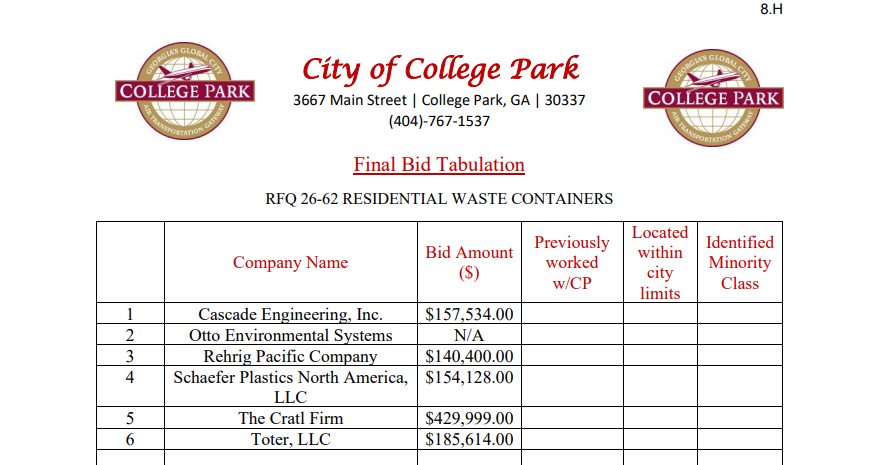
I have questions about the selected vendor, as they are not the lowest bidder of the five responses we received that included pricing. Cascade Engineering was third lowest. We do not have to go with the lowest bidder, but I do not see justification in the packet for staff’s recommendation. Cascade's quote does separate $143,234 for the containers from $14,300 for curbside distribution, however, so the gap may be narrower than it looks if the other quotes only cover containers.
Regular Session, 7:30 p.m.
7. Public Hearing
A. Public hearing and action for a reasonable accommodation request for up to eight (8) unrelated people at 2041 English Lane. This item is located in Ward 1.
The Halcyon House, LLC asked the City for a reasonable accommodation to house up to eight unrelated adults in recovery at the above address. The Council voted to deny the request in December 2025.
The applicant appealed the Council’s decision to the Superior Court of Fulton County. The court subsequently vacated Council’s denial, finding the request should have been decided after public notice and a public hearing, and that neither requirement was met. The court’s ruling was on the process, not the merits of the case. The City has been ordered by the court to reconsider the request.
8. Consent Agenda
As I’ve noted before, “[a]ccording to the Georgia Municipal Association’s Handbook for Mayors and Councilmembers, a consent agenda can be a useful tool when a governing body has a lot of business to cover. It typically includes noncontroversial items or those previously discussed and needing final approval, such as permit issuances, street closures, or bill authorizations. While a consent agenda can save time, it should never be used to bypass public participation or stifle open dialogue.”
There are some items on this meeting’s consent agenda that would be better handled during the Regular Business portion of the meeting.
C. Consideration of and action to approve a contract for a Legislative Manager/Chief of Staff for Ward 1 in the monthly amount of $6,066.67.
The salary for this position is the one budgeted for the Ward 1 Legislative Aide. There is funding for a Legislative Aide for each member of the governing body in the FY 2026-27 budget. I am concerned this newly created position, however, infringes upon the duties of the city manager. The only direct report the members of the governing body have is the city manager. Per this contract, the Legislative Manager/Chief of Staff “shall perform the Services described herein exclusively for the Office of the Ward 1 Councilmember. Contractor shall report directly and exclusively to the Ward 1 Councilmember regarding the performance of the Services under [the] Agreement.”
Our City isn’t set up like this. The elected officials are in part-time roles, with the city manager handling the day-to-day operations of the City. This arrangement appears to erode the city manager’s role. Additionally, I have concerns regarding the contractor’s prior service in other municipalities.
F. Consideration of immediate replacement of the GICC roof. Total replacement is $2,233,400.00.
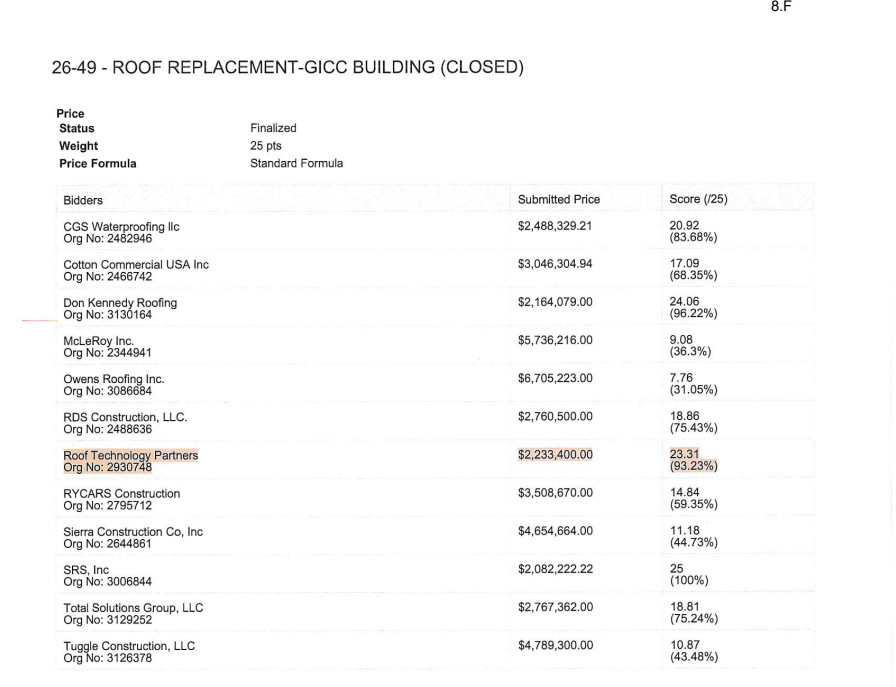
The roof at the GICC needs to be replaced. We also need to follow proper procedures in the process. The solicitation for this project drew twelve bidders. On price, the recommended vendor ranks third. SRS, Inc. submitted $2,082,222.22 and Don Kennedy Roofing submitted $2,164,079.00. Roof Technology Partners submitted $2,233,400.00.
The bid packages themselves are not in the packet. The memo also says the purchase is being made through a cooperative agreement with OMNIA Partners, but no cooperative contract appears anywhere in the item and I have concerns about such an agreement under Georgia law for a job as large as this.
Awarding a job to a contractor who is not the lowest bidder can be entirely proper, but a $2.2 million contract with a difference of more than $150,000 from the lowest bid should not pass on consent without the information that led to the recommendation in front of us.
G. Consideration of an action on a request to approve Flint Headwaters Land Access Agreement with American Rivers, INC.
The work proposed with this land access agreement would remove the existing concrete flume in which the Flint River flows, restore the natural streambed and the streamside zone, and turn a property that is currently fenced off and overgrown into a nature preserve with features such as a playground, an outdoor classroom, and trails. American Rivers is committing a minimum of $654,420 of its own grant funding to design, permit, and build the restoration.
I am excited about this project, and thankful to the people who got us here. Hannah Palmer, a Southside native and author, is the reason Finding the Flint exists. She saw a buried river and imagined a public asset, and that vision brought American Rivers, The Conservation Fund, and the Atlanta Regional Commission together around the headwaters. The late Congressman David Scott was able to secure $500,000 from the Department of Housing and Urban Development’s Community Development Fund for our City. Our staff deserves a great deal of credit as well. Grant-funded projects take years of patient coordination across federal agencies, state regulators, and regional partners, and our team has kept this project moving forward through all of it.
H. Consideration of and action on a request to approve the purchase of 2600 96-gallon universal trash containers from vendor Cascade Engineering, Inc., in the amount of $157,534.00.
This is discussed in Workshop Session item B above.
9. Regular Business
B. Consideration of and action on a request to approve P2K Civil Construction Contractors for sanitary sewer and water infrastructure improvements, including the installation of approximately 522 linear feet of 8-inch sanitary sewer main located at 4300 Spring Drive; the extension of approximately 2,800 linear feet of 8-inch water main from Herschel Road to Global Gateway Connector; and associated road milling and asphalt work, in the amount of $1,128,310.21.
The invoice for this item indicates the work is for the botanical garden, and the contract attached behind it is the City's construction contract for the Roderick Gay Botanical Garden Project, along with the botanical garden site drawings. There is no contract in the packet for the sewer and water scope we are being asked to fund. If this work is being added to the botanical garden contract, it should come to us as a change order showing the original contract amount, what has been spent, and the new total. The contract states the price may be changed only by change order. If this is new work, it should have been competitively solicited.
D. Consideration of an action on a request to approve paying The Employment Law Solution invoices in the amount of $184,416.30.
Looking at the ledger on the last page of this agenda item, it appears the most that could be due to The Employment Law Solution is actually $152,850.00, including draft invoices. If the draft invoices are removed, the outstanding amount due is $57,371.50. Either way, it does not appear $184,416.30 is the correct amount owed. I also have concerns about how payments to the vendor for $95,756.00 in March and $69,109.66 in July were authorized as I do not recall either of them being on the agenda for approval and expenditures of those amounts exceed the city manager’s spending authority under the Charter, which was increased to $25,000 earlier this year.