You’ll see below some of the agenda highlights for our first meeting in November.
I’ve added information from the council agenda memos and background on items that may be of particular interest, along with my thoughts on those issues. You can watch our meetings on the City’s Facebook and YouTube pages. Our meetings are typically on the first and third Mondays of the month.
Starting with this meeting, Workshop Session will begin at 6:00 pm and Regular Session is scheduled to start at 6:30 pm; Executive Session, if necessary, takes place at the conclusion of the Regular Session.
You can access the full agenda packets here.
We welcome your attendance at our meetings, and public comment is available near the start of the meeting, before any actions are taken. You can speak at the meeting by signing up for public comment here, starting at 4:00 pm on the day of the meeting, or by signing up in person at City Hall starting at 4:00 pm. If you have feedback for Mayor and Council directly, you can email us.
In my preview of the November 17, 2025 meeting, I raised my concerns about the adoption of a new public comment policy that eliminated the ability for comments to be emailed and read into the record. This change was placed on the agenda the day before the meeting, leaving little opportunity for the public to weigh in on a significant shift in how we engage with our stakeholders. I continue to disagree with this decision. I cannot support initiatives that make it more difficult for people to have their voices heard.
A note on Community Enhancement Funds:
In FY 2026-27, each member of the governing body has been allocated $400,000 in community enhancement funds: the funds are evenly split between capital projects ($200,000) and non-capital expenditures ($200,000). Each elected official also has a $100,000 budget for city wide events, for a total of $500,000.
Unlike the formal budgeting process undertaken by staff, where every dollar is tied to a specific line item, my colleagues and I did not go through that level of detail when these enhancement funds were allocated. As a result, some of the items being funded through these accounts are appearing for the first time on the Consent Agenda without any prior public discussion.
To ensure you have a real opportunity to weigh in on how these public funds are used (especially given the recent changes to the public comment policy), I believe any community enhancement expenditure not specifically identified in the adopted budget should appear in the Regular Business section of the agenda, not the Consent Agenda.
I will continue to provide updates detailing how your dollars are being spent. You deserve to know where and how your tax dollars are being invested.
To see the latest spending information, visit How the Math is Mathing: An Ongoing Series.
Workshop Session, 6:00 pm
A. Presentation on the Generation and Allocation of the City’s Hospitality-Related Revenues, Including TPD, DMO, and the General Fund.
The City levies an 8 percent hotel-motel tax. Under Section 11-238 of our code, 5 percent goes to uses permitted under O.C.G.A. 48-13-51(a)(3), 1.5 percent goes to a qualified destination marketing organization designated by the City, and 1.5 percent goes to tourism product development. The FY2027 budget projects $2,437,500 for each of the DMO and TPD shares. It also budgets $18,060,709 in capital projects labeled TPD. Those include $8,410,226 for the Botanical Gardens, $2,875,000 for Godby Road Park, $2,000,000 for a land purchase from Fulton County, $1,043,698 for Price Barber Shop, $650,000 for the Botanical Garden Conservancy, and $250,000 for the College Park Historical Preservation Conservancy. One line reads "GICC Building (Carn Misc. Other GICC Cap Improvements)" for $1,100,000. As of October 29, the DMO Distribution line shows $652,822.71 paid this fiscal year. The Tourist Product Development operating line has no budget, yet it shows $120,221.25 in spending. Last fiscal year, this fund transferred $9,435,885 to the General Fund, $6,960,307 to the GICC, and $1,515,711 to the Gateway Arena. The FY2027 budget shows no transfers to any of them.
Regular Session, 6:30 pm
4. Council Appointments
A. Consideration of and action on the Ward 3 Clayton County Land Bank Appointment.
The agenda refers to this as the Ward 3 appointment to the Clayton County Land Bank. However, the City of College Park has one seat on the Clayton County Land Bank board, not one seat per ward. The Land Bank board has 11 seats. Clayton County appoints four members, and each of the seven cities appoints one member. The term of the current representative for College Park ends in April 2027. She has not submitted a resignation. I am concerned that Council does not have the authority to remove a sitting member before her term ends. The packet does not cite any reason or any authority for removal, and it does not include an opinion from the city attorney.
9. Consent Agenda
A. Consideration and Approval of the Purchase and Installation of Digital Displays at the GICC from Gable Signs & Graphics, Inc., in an Amount Not to Exceed $224,592, Pursuant to the City's previously competitively solicited RFP No. 1002-2025, subject to final contract negotiations and legal review, and to authorize the City Manager to execute the final agreement without further Council action.
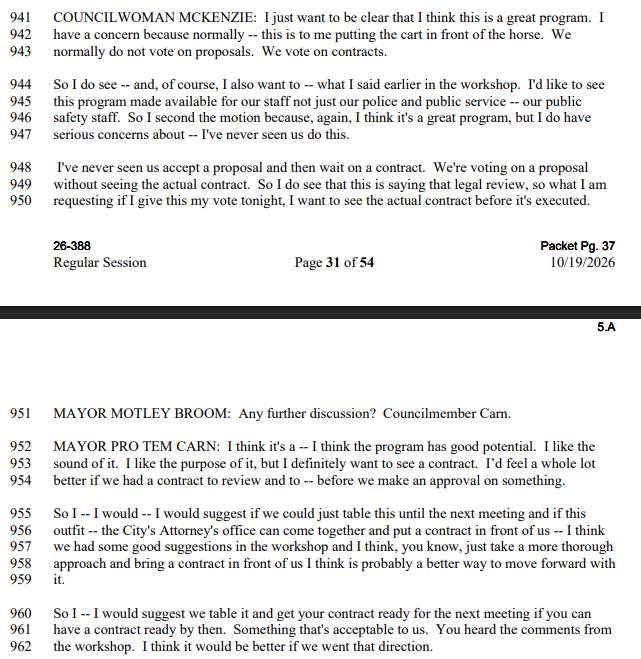
At our last meeting, two of my colleagues raised concerns about the proposal of Cycle Gang, a local business that wanted to partner with the City to provide fitness training for first responders.
Source: 11/2/2026 Regular Agenda Packet, Item 5A, Regular Session Minutes dated October 19, 2026
I understood my colleagues’ concerns and thought they were reasonable in light of the circumstances. Since that time, the city attorney’s office has worked with Cycle Gang on a contract that I hope will be on the next agenda.
In this case, staff is proposing that the governing body never see the final contract, and the Mayor’s signature would be bypassed entirely. My colleague from Ward 1 noted that she had never seen the Council “accept a proposal and then wait on a contract.” If that was a concern two weeks ago, it should remain one now, and this item should be removed from the consent agenda.
10. Regular Business
A. Pursuant to Section 8-17(e) of City Charter, the following amendment is hereby being introduced to Council on November 2, 2026 with the recommendation that it be considered for approval on November 16, 2026 as follows: Fund 100 General Fund-$3,371,617.00, Fund 221 Grants Fund-$3,772,405.08, and Fund 540 Sanitation Fund-$159,000.00.
This amendment will be introduced at the November 2 meeting for a vote on November 16. It appears under Regular Business, which is the part of the agenda where Council takes action. A request of this size should be discussed in Workshop Session first.
The proposed budget amendment totals $7,303,022.08. The Grants Fund portion is $3,772,405.08 in grant awards: $2,500,000 from the EPA for lift station repair, $800,000 for stormwater upgrades, $202,833.17 in Local Maintenance and Improvement Grant (LMIG) funds, $218,271.91 in Local Road Assistance funds, and $51,300 from the Governor's Office of Highway Safety.
The Sanitation Fund portion is $159,000 for trash can upgrades, paid for from that fund’s reserves.
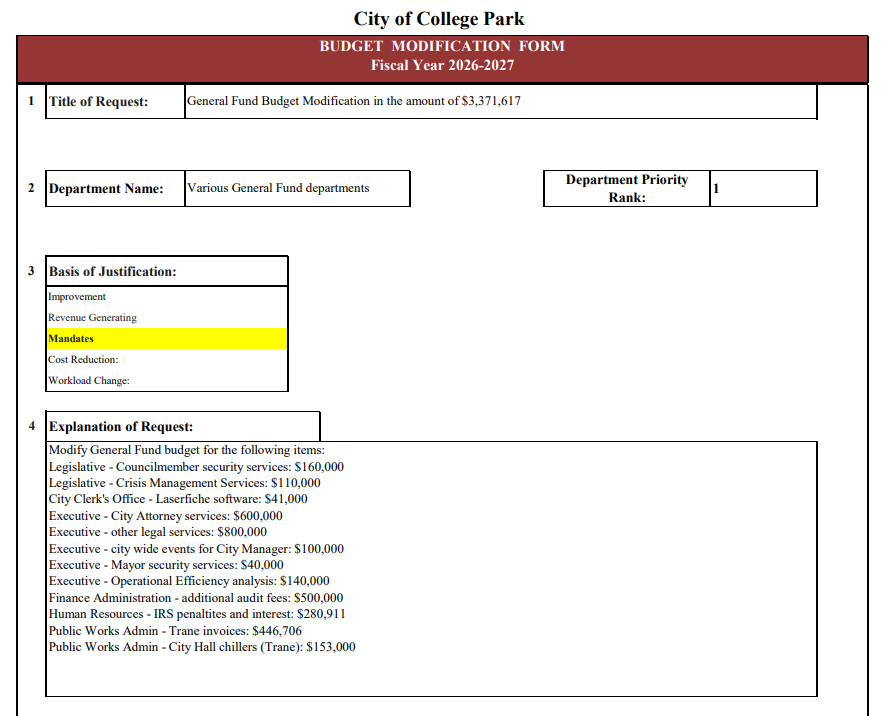
The General Fund portion is $3,371,617. It is paid for with $1,371,617 in budget carryforward, an $800,000 transfer from the FAA fund, and $1,200,000 in additional property tax revenue. If Council approves the millage advertisement at the November 2 meeting, it will hold a public hearing and vote on the millage rate on November 16. Staff proposes keeping the rate at 11.493 mills, but because property values rose, that flat rate will bring in about $1.3 million in additional property tax revenue. The $1.2 million is nearly all of that new revenue. The $1,371,617 comes from General Fund reserves, on top of the $9,107,545 in reserves the adopted budget already uses. The General Fund requests are:
Source: 11/2/2026 Regular Agenda Packet, Item 10A, Budget Modification Form
I understand the concerns regarding security of elected officials. We have seen examples of violence directed at public servants far too often across the country. If a threat is credible, there is no doubt an individual should be protected. It will be important, however, to ensure these funds respond to credible threats and are not used for threats that are nonexistent or inflated for other purposes.
I am unclear why we need $110,000 for crisis management services. We should work to avoid creating situations that require this type of spending.
The city attorney line item was budgeted at $200,000 for the year, and $303,897 had already been spent by the end of the first quarter. With this amendment, total legal spending authority would reach $1.9 million.
This amendment adds $100,000 for city manager citywide events. I do not know why the city manager would need $100,000 for events, especially when funding this initiative would require dipping into our reserves.
The audit line was budgeted at $115,000. Our auditor's September 18 memo requested a revised FY2025 audit fee of $300,000 to support additional work that needed to be accomplished. The amendment asks for an additional $500,000, which would presumably also need to cover the FY2026 audit.
The packet gives no explanation for the IRS penalties.
B. Consideration of and action on a request to approve a Resolution Establishing a 90 day Moratorium on the Purchase, Sale, Conveyance, or other transfer of Real Property within the area commonly know [sic] as the Yorktown Property in Ward 3.
The Clayton County Land Bank owns this property. While the resolution cites Georgia cases on moratoria for zoning decisions and building permits, this resolution tries to stop a change in ownership of land the City does not own. I am completely unclear how we have authority to do that, and I have asked the city attorney to inform me how this is feasible.
There is no staff analysis, no legal opinion, no map, and no description of what due diligence the City will perform, who will perform it, or what it will cost.
Develop Clayton proposed 120 for-sale units for first-time homebuyers with income levels between 80% and 120% of area median income (AMI), but the Land Bank board extended the affordability to cover 60%-80% of AMI during its last meeting, per the College Park representative to the board. The Housing Authority of Clayton County is prepared to invest in excess of $30 million in development of the site.
This appears to be an exciting opportunity to increase pathways to homeownership for those who may not be able to access it otherwise. The area is already zoned for high-density residential. This could open the door to more city employees being able to afford to live in College Park. I would hope we could all support that.
C. Consideration of and action on a request to adopt an Ordinance regarding Reasonable Accommodations in Article IX within Chapter 2 of the City's Code of Ordinances. This ordinance affects all Wards.
This proposed ordinance sets a process for people with disabilities to request reasonable accommodations from City rules, consistent with the Fair Housing Act and the Americans with Disabilities Act. The Planning Commission deferred this item on September 28 and recommended denial on October 26. Staff recommends approval. While the packet does not explain the denial, I spoke with a member of the Planning Commission who told me that no commissioner supported removing the commission from these decisions. The commissioners believe they have the training and experience to handle these requests.
They were told the change was meant to reduce the City's exposure to future lawsuits. The ordinance text matches that concern. Section 2-122 states that nothing in the Article affects the authority of the Planning Commission. Section 2-125(b), however, sends zoning and land use accommodation requests from the city planner directly to Mayor and Council. The commission's authority is preserved in words and bypassed in practice.
This is not the first time land-use decisions have been routed around the Planning Commission. In my preview of the March 23, 2026 meeting, I discussed an amendment to the subdivision ordinance that would create an "administrative approval" process for subdivision plats involving publicly owned property, including property owned by BIDA. Approval authority for publicly owned land now rests with the city engineer or the city manager. The stated reason was efficiency. My concern then was the same as now: the Planning Commission exists to provide independent oversight and a public forum, and removing that oversight moves significant decisions out of public view. In my September 8, 2026 preview, the same bypass appeared again, when a conditional height permit for land owned by BIDA or the city went forward as purely administrative rather than before the commission.
I don’t think this moves us in the right direction. Government works best when we don’t consolidate power in the hands of the few.