8/3/2026 Meeting Preview
You’ll see below some of the agenda highlights for our first meeting in August, which is also the first meeting of the 2026-2027 fiscal year.
I’ve added information from the council agenda memos and background on items that may be of particular interest, along with my thoughts on those issues. You can watch our meetings on the city’s Facebook and YouTube pages. Our meetings are typically on the first and third Mondays of the month. Workshop Session begins at 6:00 pm; Regular Session begins at 7:30 pm; Executive Session, if necessary, takes place at the conclusion of the Regular Session.
You can access the full agenda packets here.
We welcome your attendance at our meetings, and public comment is available near the start of the meeting, before any actions are taken. You can speak at the meeting by signing up for public comment here, starting at 4:00 pm on the day of the meeting, or by signing up in person at City Hall starting at 4:00 pm. If you have feedback for Mayor and Council directly, you can email us.
In my preview of the November 17, 2025 meeting, I raised my concerns about the adoption of a new public comment policy that eliminated the ability for comments to be emailed and read into the record. This change was placed on the agenda the day before the meeting, leaving little opportunity for the public to weigh in on a significant shift in how we engage with our stakeholders. I continue to disagree with this decision. I cannot support initiatives that make it more difficult for people to have their voices heard.
A note on Community Enhancement Funds:
In FY 2026–27, each member of the governing body has been allocated $400,000 in community enhancement funds: $200,000 designated for capital projects and $200,000 for non-capital expenditures. Each elected official also has $100,000 for city-wide events, for a total of $500,000.
Unlike the formal budgeting process undertaken by staff, where every dollar is tied to a specific line item, my colleagues and I did not go through that level of detail when these enhancement funds were allocated. As a result, some of the items being funded through these accounts are appearing for the first time on the consent agenda without any prior public discussion.
To ensure you have a real opportunity to weigh in on how these public funds are used (especially given the recent changes to the public comment policy), I believe any community enhancement expenditure not specifically identified in the adopted budget should appear in the Regular Business section of the agenda, not the Consent Agenda.
I will continue to provide updates detailing how your dollars are being spent. You deserve to know where and how your tax dollars are being invested.
To see the latest spending information, visit How the Math is Mathing: An Ongoing Series.
Workshop Session, 6:00 p.m.
1. Discussion regarding the Destination Marketing Organization Contract.
I have a lot of questions about this contract and I look forward to the discussion.
Since our last regular meeting on June 15, my colleagues held a special called meeting on June 28, 2026 in Savannah, for the purpose of selecting the most responsive bidder to RFP 26-60 for Destination Marketing Organization (DMO) services. I was not present at that meeting, as I was presiding over the business meeting of the Georgia Municipal Association as its president.
The special called meeting in Savannah has been the source of a great deal of controversy. The Georgia Hotel and Lodging Association (GHLA) filed a complaint with the Hotel-Motel Tax Performance Review Board, and there have been a number of DMOs with whom the winning bidder, Destination Must Visit Tourism Alliance, said they had worked, who have indicated they have done no business with the organization. Last week, the Georgia Department of Community Affairs declined to open a formal investigation into GHLA’s complaint because statutory and regulatory prerequisites were not satisfied at the time the complaint was filed. It is my understanding GHLA will be submitting another complaint to address the statutory and regulatory issues.
2. Discussion on Update of Reasonable Accommodation Procedures legislation.
There is no supporting documentation for this item.
Regular Session, 7:30 p.m.
9. Consent Agenda
As I’ve noted before, “[a]ccording to the Georgia Municipal Association’s Handbook for Mayors and Councilmembers, a consent agenda can be a useful tool when a governing body has a lot of business to cover. It typically includes noncontroversial items or those previously discussed and needing final approval, such as permit issuances, street closures, or bill authorizations. While a consent agenda can save time, it should never be used to bypass public participation or stifle open dialogue.”
A. Consideration of and action to approve a contract for a Legislative Events & Community Engagement Coordinator for Ward 1 in the monthly amount of $2,727.27.
During our last meeting of the fiscal year, the following positions were approved for Ward 1: a Community Events Consultant for $4,200.00/month, a Project Manager for $5,000.00/month, and Community Engagement and Outreach Services for $5000.00/month. Those three contracts came to over $170,000.00. This contract for consideration at Monday’s meeting is not to exceed $30,000.00. This is in addition to each member of the governing body having a Legislative Aide who earns $70,000.00/year.
B. Consideration of and action on a request for approval to purchase for the Arena entry ways, Air Curtains to combat the current high humidity levels & providing a more comfortable experience for our fans. The cost for all entry way curtains and the roll-up door is $89,583.00.
Humidity levels within the arena have been an issue. The city currently pays Johnson Controls roughly $2,500 per game to control the humidity in the arena for WNBA games to ensure the safety of the players and the comfort of the fans. However, my concern is the paperwork accompanying this agenda item. The file contains a sole source waiver signed by the City Manager on July 16, and it also contains a Georgia statewide contract award listing MaxAir as one of ten qualified mechanical contractors. Those two documents contradict one another. The waiver form asks the requester to name other available vendors and explain why they are unacceptable, and the answer names none. The memo says Purchasing vetted the vendor, but Purchasing does not appear in the routing record. The vendor's own agreement guarantees the price for only thirty days from June 16, then states the company cannot hold pricing at all and that any increase before submittal approval is a reimbursable cost, so the $89,583 may not be a firm number. This agenda item warrants further discussion.
L. Consideration of and action on a request to purchase a new 2026 Chevrolet Silverado 2500HD 4WD Crew Cab from Hardy Chevrolet in the amount of $51,034.00.
This vehicle is for Facilities Manager. This was a new position to the City last fiscal year, and the current Facilities Manager has been using his personal vehicle for City work.
10. Regular Business
A. Consideration of and action on a request to approve the assistance of the Public Works Department to pay an outstanding debt with A&S Paving in the amount of $307,215.50.
The agenda memo states this is not a budgeted item, and the work has already been completed. The job name on the invoice reads "Janice Dr. 2025-053025 Street Resurfacing, Fourth Amendment," indicating an amendment to an existing job rather than a new project, but the packet contains no contract, change order, purchase order, or bid documentation. I am unclear who authorized the work in the first place based upon the information in the packet.
B. Consideration of and action on a request to upgrade the current Laserfiche software for records retention and storage provided by MCCI in the amount of $41,355.30 for the total cost.
This is an important upgrade that would create a central repository across departments, allow remote access to contracts, MOUs, and PSAs, route documents for signature, and provide the public with read-only web access to approved records. The agenda memo states this is not a budgeted item, however, and it identifies no G/L account, fund, or transfer as the source. Before this is approved, a source of funding should be determined.
C. Consideration of and action on a request to approve and ratify the Resolution and Intergovernmental Agreement (IGA) between Fulton County and the City of College Park regarding the distribution and use of Transportation Special Purpose Local Option Sales Tax (TSPLOST) proceeds, and for other purposes.
Fulton County required execution of this Intergovernmental Agreement (IGA) by July 15, so I signed it with consensus from my colleagues to preserve the city's participation, and their vote will ratify the IGA. The agreement largely follows the 2016 and 2021 versions, with updated dates and amounts. The spending formula, contingent on voter approval, matches what we used in the last two cycles.
D. Consideration of and action on a request to approve a Resolution Amending the City of College Park Public Comment Policy
This agenda item proposes amending Resolution 2025-44, the city's public comment policy. It does two things. It eliminates the yielding, transfer, donation, or assignment of speaking time between registered speakers, and it fixes the order of speakers strictly by order of registration. It also caps the total duration of public comment at any council meeting at thirty-six minutes. At three minutes per speaker, that is twelve people total. This proposal ensures the first twelve people who sign up are able to share their thoughts. It is the second time in less than a year, however, that the time that one person can speak has been reduced. An earlier policy allowed individuals up to nine minutes to speak inclusive of time yielded to them.
F. Consideration of and action for Approval of the award of three (3) On-Call Water & Sewer Construction Services Agreements pursuant to RFQ 26- 55.
Water main breaks, sinkholes, and storm damage do not wait for a procurement cycle, and an on-call pool lets Public Works respond immediately. Staff has recommended three on-call water and sewer construction service companies: Jewel of the South, Kemi Construction, and Georgia Sewer and Storm.
G. Consideration of and action on a request to approve the distribution of funds from the Mayoral Community Enhancement account as agreed upon by the Mayor, in the amount of $84,737.00 to Public Works to fund the purchase of 2027 F350 4x2 Super Cab.
It is my goal that Mayoral Community Enhancement funds are used in ways that are tangible. You should be able to see how your tax dollars are being spent.
The staff memo for this agenda item describes the need in general fleet terms, noting that trucks are essential for transporting animals in coordination with Fulton County Animal Services and that aging equipment needs replacement. There is more to this expenditure than routine replacement, however. The air conditioning system on the current vehicle failed earlier this summer, and that failure affected the City's ability to transport animals to Fulton County Animal Services safely.
I. Consideration of and action on a request to approve a Destination Marketing Organization (DMO) Contract.
Attached to the proposed contract is a resolution that directs about $6 million in hotel-motel tax money. Where that money is going and why the split matters is important information.
The contract itself never states how much money the DMO receives. Exhibit 2 is titled "Funding and Distribution Schedule" and contains no dollar amount, no percentage, and no formula. It refers the reader to Resolution 2026-18.
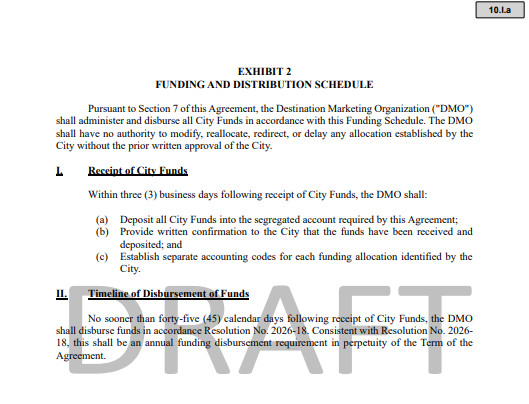
Resolution 2026-18 was passed by the Council at the June 15th meeting. It resolved that any tourism-promotion funds recovered from a former DMO would be distributed as follows: $2 million will go to a botanical garden conservancy, $1 million to a historical preservation conservancy, $1 million to the Georgia International Convention Center, $1 million to city festivals and events and $1 million to a new DMO for marketing and startup.
College Park levies an eight percent hotel-motel tax. State law sets how those dollars can be used:
At least 43.75% of the hotel-motel tax proceeds in each fiscal year must be used for tourism, conventions and tradeshows (TCT), through the DMO;
37.5% of the proceeds are non-restricted, and can be used for any legal general fund purpose in the city; and
At least 18.75% of the hotel-motel tax revenue must be used for tourism product development (TPD), otherwise it is to be used for TCT.
The Georgia Department of Community Affairs has a whole presentation about Hotel-Motel Tax. Here are some of the pertinent parts for our situation:
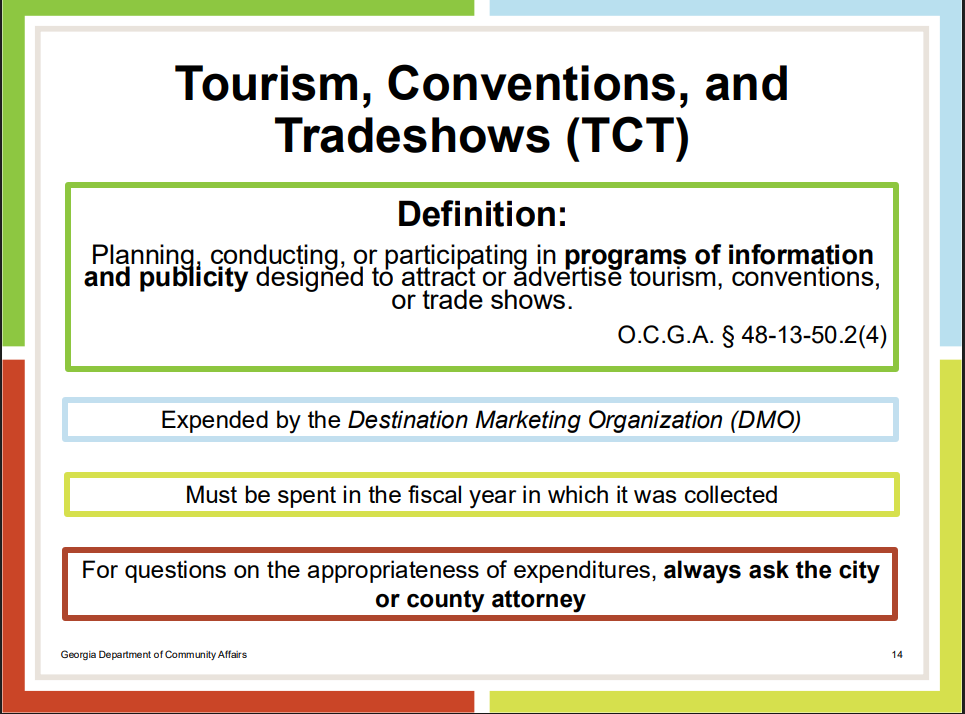
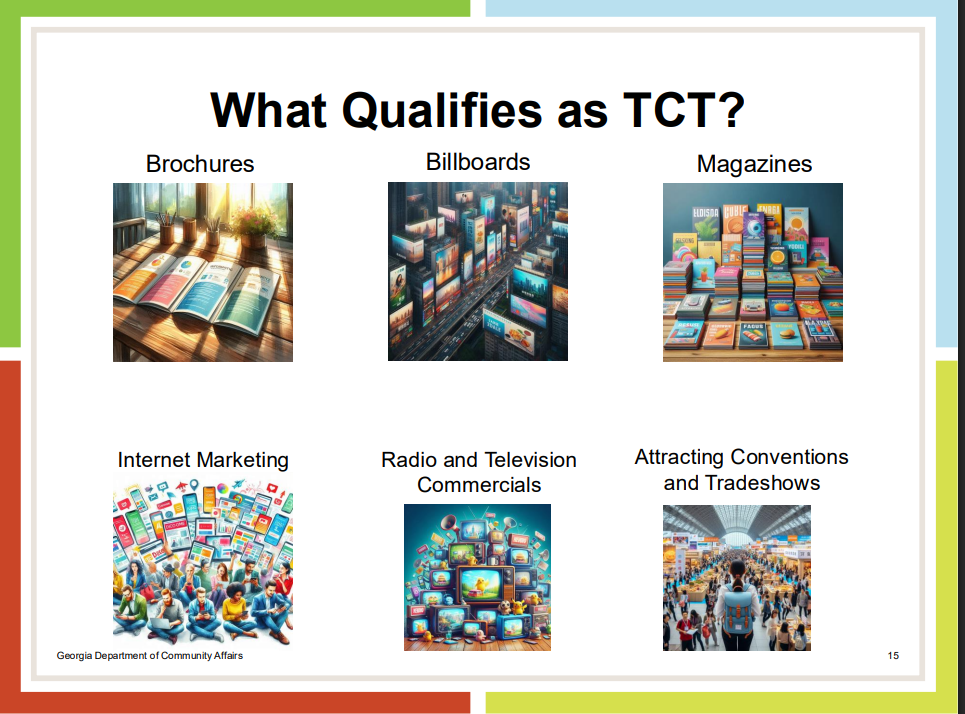
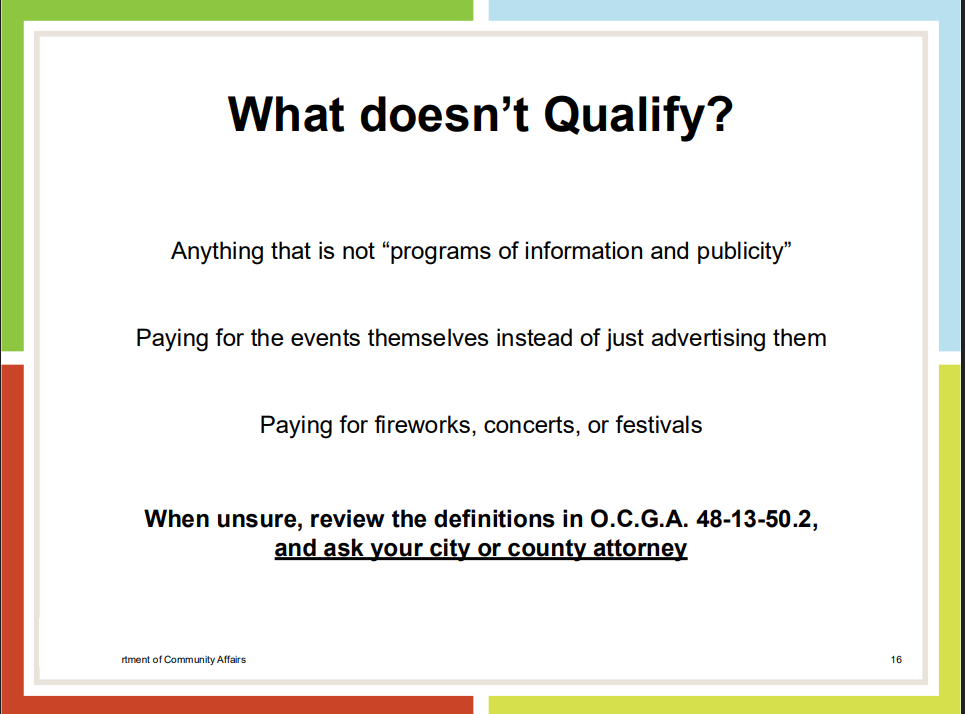
The big problem is that any funds recovered from the ATL Airport District, as Resolution 2026-18 contemplates, are restricted TCT funds. They were paid out to meet the City's tourism promotion obligation, and we reported them that way. Recovering them does not change what they are. TCT funds must be spent by a contracted DMO on programs of information and publicity. Resolution 2026-18 does not fully align with permissible uses of TCT funds.
Looking ahead, the proposed contract directs the DMO to disburse funds in accordance with Resolution 2026-18 every year, in perpetuity of the term. The funds the DMO receives, however, are TCT funds. The contract therefore instructs our new DMO to spend restricted promotion money on purposes state law does not permit, while a separate section of the same contract requires it to comply with applicable law. We should not put an organization in that position, and we should not put the City in that position either.
My concerns about the contract are above and beyond my concerns about the proposed DMO itself, which was formed about a month before it was selected by my colleagues as our new DMO. I have discussed this issue in a series of videos over the past several weeks, and you can hear my thoughts by clicking below.