5/4/2026 Meeting Preview
You’ll see below some of the agenda highlights for our first meeting in May. I’ve added information from the council agenda memos and background on items that may be of particular interest, along with my thoughts on those issues. You can watch our meetings on the city’s Facebook and YouTube pages. Our meetings are typically on the first and third Mondays of the month. Workshop Session begins at 6:00 pm; Regular Session begins at 7:30 pm; Executive Session, if necessary, takes place at the conclusion of the Regular Session.
You can access the full agenda packets here.
We welcome your attendance at our meetings, and public comment is available near the start of the meeting, before any actions are taken. You can speak at the meeting by signing up for public comment here, starting at 4:00 pm on the day of the meeting, or by signing up in person at City Hall starting at 4:00 pm. If you have feedback for Mayor and Council directly, you can email us.
In my preview of the November 17, 2025 meeting, I raised my concerns about the adoption of a new public comment policy that eliminated the ability for comments to be emailed and read into the record. This change was placed on the agenda the day before the meeting, leaving little opportunity for the public to weigh in on a significant shift in how we engage with our stakeholders. I continue to disagree with this decision. I cannot support initiatives that make it more difficult for people to have their voices heard.
A note on Community Enhancement Funds:
In FY 2025–26, each member of the governing body has been allocated $900,000 in community enhancement funds—$500,000 designated for capital projects and $400,000 for non-capital expenditures.
Unlike the formal budgeting process undertaken by staff, where every dollar is tied to a specific line item, my colleagues and I did not go through that level of detail when these enhancement funds were allocated. As a result, some of the items being funded through these accounts are appearing for the first time on the consent agenda without any prior public discussion.
To ensure you have a real opportunity to weigh in on how these public funds are used (especially given the recent changes to the public comment policy), I believe any community enhancement expenditure not specifically identified in the adopted budget should appear in the Regular Business section of the agenda, not the Consent Agenda.
As this fiscal year continues, I will provide updates detailing how your community enhancement dollars are being spent. You deserve to know where and how your tax dollars are being invested.
To see the latest spending information, visit How the Math is Mathing: An Ongoing Series.
Workshop Session, 6:00 p.m.
1. Discussion regarding adopting the Georgia Water Planning District Model
The City is required by the Metropolitan North Georgia Water Planning District to adopt a local ordinance on drought response and water waste. The ordinance establishes what counts as water waste, sets year-round watering hour restrictions (no outdoor irrigation between 10 a.m. and 4 p.m.), and creates a tiered response system for declared drought levels. At Level 2, outdoor irrigation is limited to two days per week. At Level 3, outdoor irrigation is banned with limited exceptions. Violations start with a written warning and can escalate to fines and water shut-off.
2. Discussion regarding the adoption of Local Amendment to Plumbing Code: Metropolitan North Georgia Water Planning District Water Efficiency Code
This amendment is also required under the Metropolitan North Georgia Water Planning District's 2022 Water Resources Management Plan. This ordinance updates local plumbing standards to require more water-efficient fixtures in new construction and substantial renovations. Changes include lower maximum flow rates for showerheads (2.0 gallons per minute), lavatory faucets (1.2 gpm), and kitchen faucets (1.8 gpm), along with updated irrigation system design and component requirements. This is a required compliance item for the 2024–2025 Georgia Environmental Protection Division audit.
3. Discussion on an Ordinance to Amend Chapter 4 (Animals and Fowl) of the City’s Code of Ordinances to Update Dangerous Dog Regulations
This proposed ordinance modernizes the City's animal control regulations to align with current Georgia law. The existing ordinance uses outdated language and does not fully reflect the state's behavior-based classification system. The update replaces breed-based provisions with a documented-conduct framework, establishes clear procedures for investigation, classification, hearings, and appeals, and sets owner requirements for registration, enclosure, restraint, and insurance.
This update coincides with the opening of our first public dog park. Under the new framework, dogs are classified as either "dangerous" or "vicious" based on documented conduct, not breed. A dangerous dog is defined as one that causes a substantial puncture of a person's skin, aggressively attacks in a way that causes a reasonable person to fear serious injury, or kills a pet animal while off the owner's property. A vicious dog is defined as one that inflicts serious injury on a person or causes serious injury resulting from a person's reasonable attempt to escape an attack.
The ordinance establishes a structured process: the animal control officer investigates, issues a written determination, and notifies the owner within 72 hours. Owners have seven days to request a hearing before Mayor and City Council. If no hearing is requested, the classification becomes final.
Owner responsibilities increase with the level of classification. Owners of dangerous dogs must maintain a proper enclosure, post visible warning signage, and keep the dog securely leashed when off the property. Owners of vicious dogs must also muzzle the dog off the property, carry liability insurance or a surety bond, microchip the dog, prohibit handling by minors, and notify the City within 24 hours if the dog escapes or bites anyone.
Regular Session, 7:30 p.m.
7. Public Hearings
A. Redevelopment Plan Amendment
A public hearing is required under O.C.G.A. § 36-44-7 before Council votes on a resolution to amend the 2025 College Park Redevelopment Plan. The plan was originally adopted December 1, 2025 under the Redevelopment Powers Law. Since adoption, Council has expanded two redevelopment areas by separate resolutions: Resolution No. 2026-02 expanded the Old National Corridor area in February 2026, and Resolution No. 2026-10 expanded the Six West area in April 2026. The amendment before Council on Monday formally incorporates those expansions into the plan itself, revising the boundaries and replacing Exhibit A with an updated map and legal description.
The College Park Business and Industrial Development Authority (BIDA) is a separate authority operating under a state constitutional amendment, with its own board, its own mandate, and independent authority to issue bonds, acquire property, and enter into development agreements.
Both bodies are now operating in overlapping geographic and functional territory. The redevelopment area has been expanded twice since February, covering corridors like Old National and Six West that are also areas of active interest for business and industrial development. What is not clearly defined is how decisions get made when both bodies have an interest in the same property or corridor. I am concerned these two entities will conflict with one another sooner rather than later.
8. Consent Agenda
As I’ve noted before, “[a]ccording to the Georgia Municipal Association’s Handbook for Mayors and Councilmembers, a consent agenda can be a useful tool when a governing body has a lot of business to cover. It typically includes noncontroversial items or those previously discussed and needing final approval, such as permit issuances, street closures, or bill authorizations. While a consent agenda can save time, it should never be used to bypass public participation or stifle open dialogue.”
Monday’s Consent Agenda contains items from staff that appear to be properly vetted and documented. I don't have any concerns.
B. Consideration of and action on a request for approval of ball field lights for Zupp Park from Gresco as a sole provider, at a cost of $47,542
The ball field lights for Zupp Park are listed as a sole-source purchase from Gresco at $47,542. Sole-source procurement, buying from a single vendor without competitive bidding, is a legitimate exception to standard purchasing rules when only one vendor can provide what is needed. That is the case here.
The existing lighting at other City parks uses the Ephesus LumaSport 8, a proprietary sports lighting platform made by Cooper Lighting. No other manufacturer makes equipment that interfaces with that infrastructure. Bringing Zupp Park's ball fields onto the same system as we have in our other parks requires matching components.
9. Regular Business
E. Consideration of and action on a request to approve the most responsible and lowest apparent bidder, Atlanta Paving Concrete, for ITB 26-44 Repaving Parking Lot & Streets-GICC in the amount of $1,393,245.24
The agenda notes this is a budgeted item, but I cannot find support for that in the budget that was passed for this fiscal year. I have asked staff for clarification and when I receive a response, I will share it with you.
The GICC’s 5-Year Capital Improvement Plan shows parking lot repaving in our upcoming fiscal year (FY 2026-27). The estimate for the project in that plan was $1,000,000.
The funding source noted in the supporting documents for this agenda item is the Tourism Product Development (TPD) fund. We have been doing a lot of spending from that fund as of late. We have committed hundreds of thousands of dollars to two newly formed conservancies (Botanical Garden and Historical Preservation), among other projects.
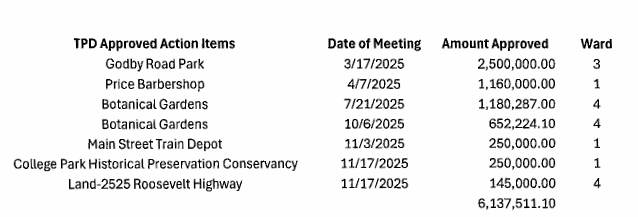
Source: 2/16/2026 Regular Agenda Packet, p. 321
The TPD fund is a restricted revenue source tied to our hospitality economy. Decisions about how it is spent should be part of a deliberate, publicly vetted plan that is part of the budgeting process, not made on an item-by-item basis without a comprehensive strategy.
G. Consideration of and action on a request to approve the Zupp Park playground project and related park improvements in the total amount of $800,000, including $525,000 to Kompan, Inc. for playground and adult fitness equipment, installation, and related items, and $55,000 to Metrocorp Development Enterprises, Inc. for project management and design
The agenda memo reflects the vendor was selected via a cooperative purchasing agreement. Georgia law requires public works construction contracts over $250,000 to go through a competitive sealed bidding process. The project budget is $800,000.
I have reached out to the City Attorney for clarification and will share more information once I receive it.