2/2/2026 Meeting Preview
You’ll see below some of the agenda highlights for our first meeting in February. I’ve added information from the council agenda memos and background on items that may be of particular interest, along with my thoughts on those issues. You can watch our meetings on the city’s Facebook and YouTube pages. Our meetings are typically on the first and third Mondays of the month. Workshop session begins at 6:00 pm; regular session begins at 7:30 pm; executive session, if necessary, takes place at the conclusion of the regular session.
You can access the full agenda packets here.
We welcome your attendance at our meetings, and public comment is available near the start of the meeting, before any actions are taken. You can speak in person at the meeting by signing up for public comment here, starting at 4:00 pm on the day of the meeting, or in person at City Hall starting at 4:00 pm. If you have feedback for Mayor and Council directly, you can email us.
This is our third meeting with the new public comment policy. In my preview of the November 17, 2025 meeting, I noted my concerns about the adoption of this policy, especially considering it was placed on the agenda the day before the meeting with very little opportunity for the public to weigh in on this significant shift in how we engage with our stakeholders. I still do not agree with this change. I cannot be in support of initiatives that make it more difficult for people to have their voices heard.
A note on Community Enhancement Funds:
In FY 2025–26, each member of the governing body has been allocated $900,000 in community enhancement funds—$500,000 designated for capital projects and $400,000 for non-capital expenditures.
Unlike the formal budgeting process undertaken by staff, where every dollar is tied to a specific line item, my colleagues and I did not go through that level of detail when these enhancement funds were allocated. As a result, some of the items being funded through these accounts are appearing for the first time on the consent agenda without any prior public discussion.
To ensure you have a real opportunity to weigh in on how these public funds are used (especially given the recent changes to the public comment policy), I believe any community enhancement expenditure not specifically identified in the adopted budget should appear in the Regular Business section of the agenda, not the Consent Agenda.
As this fiscal year continues, I will provide updates detailing how your community enhancement dollars are being spent. You deserve to know where and how your tax dollars are being invested.
You can see how community enhancement funds have been spent since the beginning of the fiscal year, from July 1st through October 6, 2025 by clicking here. I will continue to supplement this information as I receive additional ledgers.
(Note: there is some overlap in the earlier information as I changed the parameters of my requests.)
I have also received questions about our overall spending. You can see all of the payments the city has made this fiscal year below. I will also update these records as I receive them.
November 2025 — NEW
WORKSHOP SESSION
1. Discussion on the Unhoused Initiative Fund. Presentation from the Youth Civic Advisory Board (YCAB). This item is sponsored by Councilwoman Jamelle McKenzie.
I appreciate the Youth Civic Advisory Board bringing forward this idea and the care they’ve shown in identifying a real need in our community. They have clearly been thoughtful about their approach to this issue and we share a goal of supporting residents who are struggling.
This request includes the use of public funds. We have to ensure it is structured in a way that allows us to stay in compliance with the gratuities clause of Georgia Constitution. As the proposal is currently presented, there are some legal and process questions we would need to work through.
I look forward to this conversation and working together to explore a structure that both supports the students’ vision and ensures we’re doing this in a way that is legally sound.
3. Discussion of an Ordinance to Adopt Article XVIII (Short-Term Rentals) Within Chapter 5 of the College Park Code of Ordinances. This item is sponsored by Councilwoman Jamelle McKenzie.
At a high level, the ordinance recognizes an important reality: short-term rentals already exist in our community. Rather than leaving them unregulated or addressed only through complaints, this proposal seeks to bring structure, clarity, and accountability to how they operate, while also prioritizing neighborhood quality of life.
There are several positive elements worth highlighting.
First, the ordinance creates a licensing and regulatory system. That structure helps the City track short-term rentals, set expectations, and enforce standards consistently. Clear rules are better for residents, property owners, and staff than uncertainty or uneven enforcement.
Second, the ordinance explicitly acknowledges neighborhood impacts. By addressing issues such as noise, occupancy, and operations, it attempts to balance economic opportunity with the need to protect residential areas. That balance is essential in a city like ours, where we have to balance the importance of stable neighborhoods while also being the gateway to our region and the world with the presence of Hartsfield-Jackson Atlanta International Airport.
Third, the ordinance includes enforcement tools and an appeals process. This provides the City with mechanisms to address violations while also ensuring fairness and due process for property owners.
There are also implementation details that deserve careful discussion and I am encouraged we can have those conversations in our Workshop Session.
One area that raises practical questions is the neighbor consent requirement. While the intent is to give nearby residents a voice, consent-based provisions can be challenging to administer fairly. For example, if a neighboring property is owned by an LLC rather than an individual, it may not always be clear who is authorized to provide consent. That creates ambiguity and could lead to delays or inconsistent outcomes.
There is also the reality that neighbor consent can be influenced by personal relationships rather than land-use impacts. In situations where neighbors have longstanding disagreements or personality conflicts, a consent requirement could effectively function as a veto unrelated to noise, safety, or actual operational concerns. That dynamic has the potential to create uneven application of the ordinance and could place staff in difficult positions.
Another area that would benefit from clarification is how properties “across the street” are defined. Questions arise around corner lots, offset properties, unusually wide rights-of-way, and non-traditional street layouts. Clear definitions, ideally developed with input from our Planning Department, could help ensure the ordinance is applied consistently across the city.
There is also an important fiscal question worth asking: does the proposed licensing fee accurately reflect the true cost of administering the program? Licensing, compliance reviews, inspections, complaint response, enforcement actions, and appeals all require staff time. If the fee is set too low, those costs may be absorbed by the general fund rather than borne by the activity being regulated. A clear understanding of actual staff time and administrative costs will help ensure the program is both fair and sustainable.
Finally, as with any new regulatory framework, it will be important to understand how this ordinance will be enforced over time and whether adequate resources are in place to support it effectively.
REGULAR SESSION
9. Consent Agenda
As I’ve noted before, “[a]ccording to the Georgia Municipal Association’s Handbook for Mayors and Councilmembers, a consent agenda can be a useful tool when a governing body has a lot of business to cover. It typically includes noncontroversial items or those previously discussed and needing final approval, such as permit issuances, street closures, or bill authorizations. While a consent agenda can save time, it should never be used to bypass public participation or stifle open dialogue.”
For the second time in as many meetings, all of the consent agenda items are from staff. This is a welcome trend.
H. Consideration of and action on a request to approve a Change Order for S.T. English Construction Company in the amount of $46,847.00 to furnish the Paws On Main Dog Park located in Ward 4. This is an FY26 budgeted item (G/L Account #100 6122 54 7920). This item is sponsored by Interim Director of Recreation and Cultural Arts, Lance Terry.
Change orders are a normal part of capital projects. When a project is approved, governing authorities often include a contingency so that necessary items can be addressed as construction progresses without having to reopen the full project budget. In this case, the 10% contingency approved with the original project is being used to add furnishings to make the park fully functional for residents. I have asked staff for details on what has been spent thus far and for what purpose. I have also asked for clarification on the specific furnishings included in this change order and will share that information once it is provided.
10. Regular Agenda
A. Consideration of and action on a request to approve a Resolution Expanding the Redevelopment Area of the City. This item is sponsored by City Attorney Winston Denmark.
I am still concerned, as I was back in October and November about the Redevelopment Authority. The new area (see below) would include 2135 Godby Rd., the former Chelsea Gardens property among others, and I continue to have questions about how this expansion aligns with prior commitments and oversight structures, including the Business and Industrial Development Authority (BIDA).
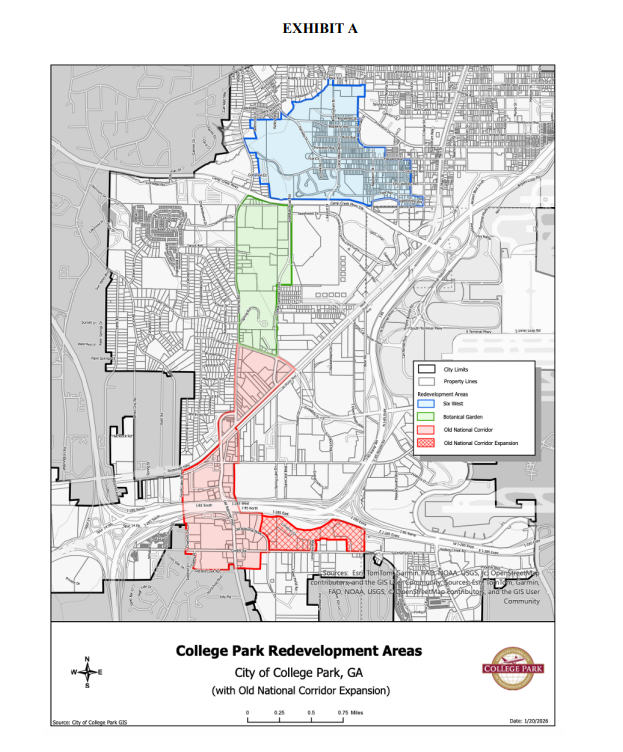
Proposed Redevelopment Authority Expansion Area
D. Consideration of an action on a request to authorize $30,000.00 for a Citywide Concert in Conjunction with the 17th Annual Senior Social. This is a budgeted item under Ward 4 – Community Enhancement (Non-Capital) GL Account #100-1100-52-7284. This item is sponsored by Councilman Roderick Gay.
In the agenda memo, the following is noted:
“This is a budgeted item. Ward 4 – Community Enhancement (Non-Capital) GL Account #100-1100-52-7284. Inasmuch as the Community Enhancement budget may be temporarily unavailable at the time of payment, pledged sponsorships, confirmed donations, and/or other lawful reallocations shall reimburse any fund deemed available by Finance to initially cover this expense, resulting in no net fiscal impact to the City.”
It’s not clear to me exactly what that means. I asked staff about this, and was informed their understanding is the Ward 4 Non-Capital account has sufficient funds to cover this expenditure. If there are any updates before the meeting that change that understanding, I will let you know.
UPDATE (2/2/2026, 9:20 am): The balance in the Ward 4 Non-Capital Community Enhancement Account is $27,886.53.
E. Consideration of and action on a request to Amend the Purchasing Policy Threshold increasing the City’s purchasing threshold from $10,000 to $25,000 to align with current market conditions and improve operational efficiency. This item is being requested by Michael Hicks, Interim City Manager.
I understand and agree with the reasoning behind raising the City Manager’s spending threshold to $25,000, and the agenda memo lays out those reasons well. However, it is my understanding that the City Manager’s spending authority is set in the City Charter. Because of that, it raises the question of whether a charter amendment would be required before this change could take effect. While this type of amendment would not alter our form of government and could likely be handled locally, it would still require proper public notice through the legal organ and other required steps.
F. Consideration of and action on a request to approve an Ordinance to Amend Chapter 3 (Alcoholic Beverages), Article II (Licenses), Section 3-27 of the City of College Park Code of Ordinances Regarding Distance Requirements for Malt Beverages and Wine by the Drink. This item is sponsored by Councilwoman Tracie Arnold.
This proposed change would bring our ordinances in line with state law, rather than keeping more restrictive local rules. It would allow establishments that are more than 100 yards from a school, or more than 50 yards from a place of worship or a public library, to sell malt beverages or wine by the drink. Right now, those same establishments are required to be at least 200 yards away, so this would be a shift toward a more flexible standard.