6/15/2026 Meeting Preview
You’ll see below some of the agenda highlights for our second meeting in June. We’re not having a scheduled meeting in July, so our next meeting won’t be until August 3rd.
I’ve added information from the council agenda memos and background on items that may be of particular interest, along with my thoughts on those issues. You can watch our meetings on the city’s Facebook and YouTube pages. Our meetings are typically on the first and third Mondays of the month. Workshop Session begins at 6:00 pm; Regular Session begins at 7:30 pm; Executive Session, if necessary, takes place at the conclusion of the Regular Session.
PLEASE NOTE: We also have a special called meeting at the conclusion of executive session tomorrow night, to make a decision about RFP 26-57, regarding a Destination Marketing Organization. I have more thoughts about this below.
You can access the full agenda packets here.
We welcome your attendance at our meetings, and public comment is available near the start of the meeting, before any actions are taken. You can speak at the meeting by signing up for public comment here, starting at 4:00 pm on the day of the meeting, or by signing up in person at City Hall starting at 4:00 pm. If you have feedback for Mayor and Council directly, you can email us.
In my preview of the November 17, 2025 meeting, I raised my concerns about the adoption of a new public comment policy that eliminated the ability for comments to be emailed and read into the record. This change was placed on the agenda the day before the meeting, leaving little opportunity for the public to weigh in on a significant shift in how we engage with our stakeholders. I continue to disagree with this decision. I cannot support initiatives that make it more difficult for people to have their voices heard.
A note on Community Enhancement Funds:
In FY 2025–26, each member of the governing body has been allocated $900,000 in community enhancement funds: $500,000 designated for capital projects and $400,000 for non-capital expenditures.
Unlike the formal budgeting process undertaken by staff, where every dollar is tied to a specific line item, my colleagues and I did not go through that level of detail when these enhancement funds were allocated. As a result, some of the items being funded through these accounts are appearing for the first time on the consent agenda without any prior public discussion.
To ensure you have a real opportunity to weigh in on how these public funds are used (especially given the recent changes to the public comment policy), I believe any community enhancement expenditure not specifically identified in the adopted budget should appear in the Regular Business section of the agenda, not the Consent Agenda.
As this fiscal year continues, I will provide updates detailing how your community enhancement dollars are being spent. You deserve to know where and how your tax dollars are being invested.
To see the latest spending information, visit How the Math is Mathing: An Ongoing Series.
Workshop Session, 6:00 p.m.
1. Presentation on Electric Residential Rates by Power Department Director Hugh Richardson.
The Georgia Public Service Commission surveys all 94 electric power providers in the state twice a year. That data is in the packet and it shows that College Park Power ranks 92nd out of 94 providers. We are consistently 25 to 31 percent below the Georgia average. At 1,000 KWH year-round, College Park residents pay $114 per month. The Georgia average is $144. The US average is $176. College Park Power has also been lowering rates every year since 2023, producing average savings of $33 per month for residents, while still transferring $4.8 million to the general fund and contributing $2.6 million in franchise fees.
The workshop presentation also covers the proposed veteran residential rate. Veterans under 65 would receive the same rate as our senior residents. Veterans 65 and older would get an additional benefit: the year-round winter rate, which is our lowest. Staff is proposing city residents who are honorably discharged veterans of the US Armed Forces (or their surviving spouse) with a utility account in their name would be eligible to apply for this discount in person with DD Form 214.
Items 9A and 9B on the consent agenda are based upon this presentation.
2. Presentation from Tarshema Harris on a Community Economic Development, Business Activation & Destination Strategy Year One Engagement Consulting Proposal.
The proposal lays out four "lanes" of work: community activation (signature events, corridor pop-ups, an annual event calendar), stakeholder engagement (business owner roundtables, DMO-Economic Development alignment), business growth (a funding concierge, small business bootcamps, a Black business excellence initiative, a curated business directory), and implementation support (a year one strategic framework, quarterly reports, and a community belonging and housing strategy).
I am unclear from the supporting documentation or the presenter’s website how this aligns with our strategic plan, our comprehensive plan and our current staff. Some of this seems duplicative and I am concerned about the cost ($90,000) as well.
It is also noteworthy that this proposal explicitly references a new DMO being stood up, treating it as a given. More on that later.

Tarshema Harris Consulting Proposal, Workshop Packet page 28
Regular Session, 7:30 p.m.
9. Consent Agenda
As I’ve noted before, “[a]ccording to the Georgia Municipal Association’s Handbook for Mayors and Councilmembers, a consent agenda can be a useful tool when a governing body has a lot of business to cover. It typically includes noncontroversial items or those previously discussed and needing final approval, such as permit issuances, street closures, or bill authorizations. While a consent agenda can save time, it should never be used to bypass public participation or stifle open dialogue.”
Unfortunately, we’ve taken a backslide with this consent agenda. There are 14 items to be considered, and a number of them warrant additional discussion.
C. Consideration of and action on a request to approve improvements to the Charles E Phillips parking lot totaling $300,000.00. This item is requested by Lance Terry, Interim Director, Recreation and Cultural Arts. This is a budgeted item for Fiscal Year 2025-2026 (GL Account Recreation Capitol Project - 100 6122 54 7920). This will service Ward 4.
We’ve spent a lot repaving this parking lot. This additional work will bring the project close to $1 million. You can see what the additional funding will cover here.
H. Consideration of and action to approve a 12-month Professional Services Agreement with Jay Productions Agency LLC as Ward 1 Community Events Consultant with a monthly compensation amount of $4,200.00.
See Items 10K and 10L below for my comments.
K. Consideration of and action on a request to approve the distribution of funds from the Mayoral Community Enhancement account as agreed upon by the Mayor, in the amount of $250,407.00 to Public Works to fund the purchases of a Mobile Water Trailer, three 2WD Chevrolet SIlverado Crew Cabs Trucks, two Chevrolet Silverado 4WD Crew Cab Trucks, One Hyundai Lift Truck. This agenda item is being requested by Public Works Director, Brian Anderson.
As I’ve shared before, it’s important to me that your community enhancement funds go towards tangible projects that improve your quality of life. I don’t think it should be on the consent agenda, as it is not a budgeted item in the sense that these particular items were not listed in our FY2025-2026 budget for purchase. But they will help facilitate the work that our teams do and that directly impacts the level of service you receive.
M. Consideration of and action on a request to approve the lowest apparent bidder, RSW Services for ITB 26-56 Camp Creek Improvements II, in the amount not to exceed $98,800.00. This is a budgeted item (Community Enhancement 100-1100-52-7282 FY26-27). This item is being requested by Mayor Pro Tem Joe Carn. This item will service Ward 2.
The lowest apparent bidder is the company owned by the chair of our development authority. That bid is 40% less than the next highest bidder.
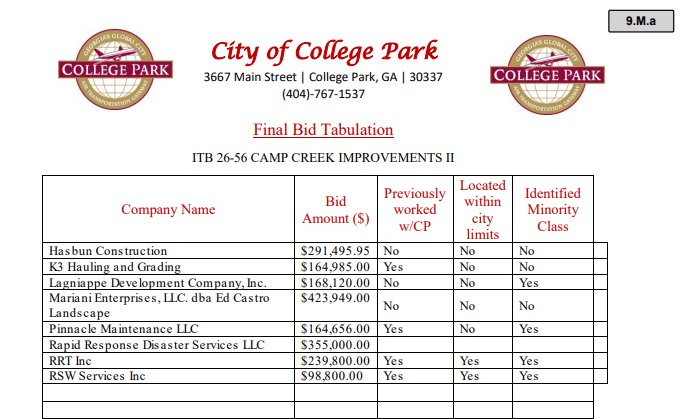
Final Bid Tabulation, ITB 26-56
This was the second Invitation to Bid posted for this project. The first, ITB 26-50, was published April 27, 2026, and closed May 11, 2026. The scope of work for ITB 26-50 included retaining wall construction and benches that were absent from the scope of work for ITB 26-56. ITB 26-56 was published the day after ITB 26-50 closed on May 12, 2026, and closed on May 26, 2026.
N. Consideration of and action on a request to approve RFP 26-42 - RESURFACING COMMUNITY PARKS to Ranger Rubber the most responsive & responsible bidder in the amount of $280,340.00 to provide safe, environmentally responsible resurfacing of three community playgrounds; Subrenia Miller Willis Park, Barrett Park, and Badgett Stadium Playground. This item is requested by Lance Terry, Interim Director, Recreation and Cultural Arts Department. This is a budgeted item (G/L Account Fund Recreation Facilities #221-6122-54-7851 FY26- 27). This item will service Wards 1 & 2.
Staff’s recommendation is not the lowest bidder, but the notes from the review of the bidders indicate Ranger Rubber was the most responsive bidder.
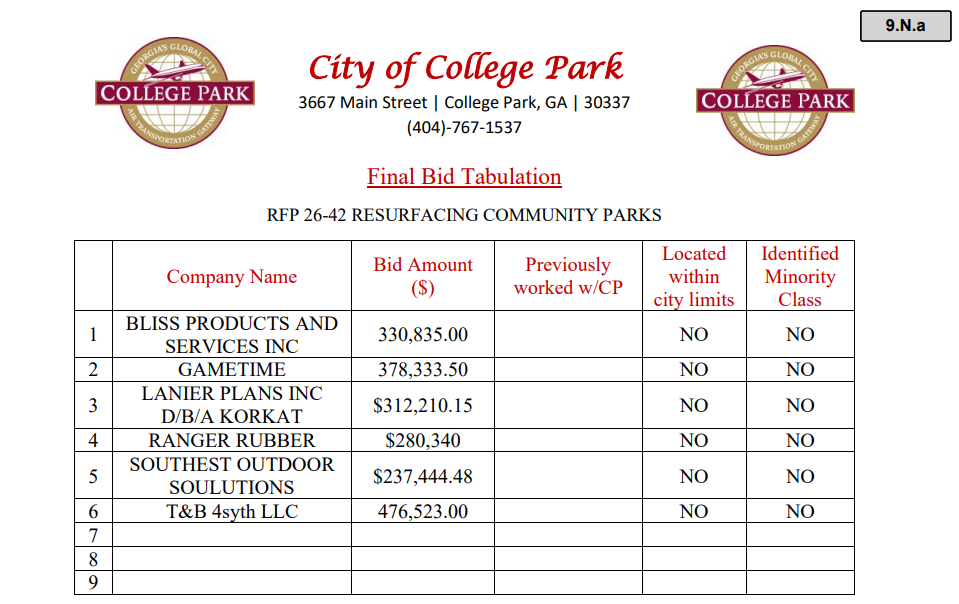
Final Bid Tabulation, RFP 26-42
10. Regular Business
B. Consideration of and action on a request for approval of the City-wide Compensation Study to adjust all full-time and part-time employee salaries in the amount of $2,008,514.
The recommendation of staff is to move our salaries from the 48th percentile of comparable organizations to the 55th percentile. This is a start, but it’s still not where we need to be. It still places us in the middle of the pack when it comes to compensation.
E. Consideration of and action on a request to approve an Ordinance regarding Transient Lodging Establishment Regulations.
The ordinance makes it unlawful to establish, advertise, list, rent, or solicit bookings for any short-term rental that is already prohibited under the City's zoning ordinance. It defines "Responsible Party" broadly: owners, property managers, hosts, local contacts, and anyone exercising control are jointly and severally liable. Evidence of a violation can include online listings, booking calendars, the presence of a lockbox or keypad entry system, utility usage patterns, neighbor complaints, and frequent turnover of occupants or vehicles. No prior citation is required before the city can commence nuisance abatement proceedings in Municipal Court. Each day a violation continues, and each individual booking, may be treated as a separate violation.
F. Consideration of and action on a request to approve an Ordinance Amending Chapter 8 (Health and Sanitation) Relating to Litter Control and Dumpster Enclosures.
This ordinance does two things. It revises the penalty structure for existing litter control violations, and it creates a brand new section establishing minimum standards for dumpster enclosures and refuse containers.
On litter control, the revised penalties are: $250 minimum for a first conviction, $500 for a second within 12 months, and $1,000 mandatory for a third or subsequent offense. Each day a violation continues after notice is a separate offense. Violators also reimburse the city for cleanup costs.
On dumpster enclosures, the new standards apply to all commercial, industrial, institutional, mixed-use, multifamily, and nonresidential properties. All dumpsters and compactors must be located within a permanent enclosure made of masonry, decorative metal, wood, or composite material. Enclosures must be tall enough to fully screen containers from public view, include opaque gates, and be kept free of graffiti and disrepair. Property owners, tenants, and managers are all responsible for maintenance. Violations carry the same $250/$500/$1,000 fine structure, with each day constituting a separate offense.
Clean commercial corridors matter. The underlying intent is sound, but I have serious concerns about the process and the implementation.
Our stakeholders will be seeing this ordinance for the first time at this meeting. There has been no first reading, no workshop, no notice to affected property owners, and no ramp-up period built into the ordinance before enforcement begins. Unfortunately, we have seen this pattern before: new ordinances passed one night, code enforcement out writing citations days later, with businesses having had no opportunity to come into compliance. That is not fair to business owners who are trying to do right by this city.
The enclosure requirement is also an added capital expense at a time when the challenges of being a small business owner are increasing. Permanent masonry or metal structures are not cheap, and asking businesses to absorb that cost with no notice and no timeline is unreasonable.
I also want to raise something specific about the graffiti provision. Some business owners in College Park have taken it upon themselves to commission murals and artwork on their dumpsters. That is not blight. That is community investment. This ordinance as written could be used to cite those businesses for "graffiti" on what is actually intentional art. That ambiguity needs to be addressed before this becomes law.
We have already seen what selective code enforcement looks like in College Park. I am not in favor of handing code enforcement new tools without first ensuring there are clear guardrails on how those tools are used, adequate notice to the people being regulated, and a fair timeline to comply.
G. Consideration of and action on a request to approve an Ordinance Adopting a Vacant Buildings Registration and Maintenance Program.
Under this ordinance, any building unoccupied for 90 or more consecutive days is considered vacant. Owners must register with the Building and Inspections Department within 30 days of the building becoming vacant and renew annually. Registration fees will be set by council resolution. Maintenance requirements include securing all entry points, maintaining structural integrity, keeping the premises free of trash, debris, graffiti, and overgrown vegetation, and preventing conditions that attract rodents or unlawful activity. The city may inspect for compliance at any time and can recover all costs incurred in securing or maintaining a non-compliant property.
Penalties are $500 for a first offense, $750 for a second within 12 months, and $1,000 for a third. Each day is a separate offense.
Addressing vacant and blighted properties is a legitimate goal. My concern here is yet again, the public’s only opportunity to weigh in on this is the same day the ordinance may become law. It deserves a first reading at a workshop and an opportunity for stakeholders to be able to properly evaluate it before any vote is taken.
H. Consideration of and action on a request to approve an Ordinance Establishing Destination Marketing Organization (DMO) Standards and Accountability Requirements.
This new ordinance would establish standards for any Destination Marketing Organization receiving city funds.
While the accountability provisions in the ordinance are reasonable on their face, there are aspects of the ordinance that seem specifically targeted to exclude our current DMO, namely the “direct benefit” restriction. The ordinance states that city funds may not be expended primarily for the promotion, marketing, operation, development, support, or benefit of another municipality, county, destination, attraction, event, facility, or tourism initiative, unless specifically approved by the Mayor and Council and demonstrated to provide a direct and substantial benefit to the City.
The ATL Airport District is a regional destination marketing organization. College Park is a member alongside Fairburn, South Fulton, Union City, and Hapeville. The District receives 1.5% of hotel-motel tax revenues directly under state law, uses those funds to recruit conventions, meetings, and large events to the GICC and Gateway Arena, and markets the corridor as a unified destination. The "direct benefit" restriction is written in a way that would make it very difficult, if not impossible, for a regional marketing organization to satisfy the ordinance's requirements.
My predecessor, Mayor Jack Longino, understood the value of this regional approach and helped build it. When visitors know they have options like the Porsche Experience in Hapeville and Fairburn’s Renaissance Festival while they’re attending their conference in College Park, it benefits all of us.
I. Consideration of and action on a request to approve Resolution Establishing Policy Guidance for Destination Marketing Organization (DMO) Funding, Oversight, and Tourism-Promotion Funds.
This is a companion resolution establishing the City's policy for the use, expenditure, oversight, and administration of tourism-promotion funds in connection with the DMO program. The agenda memo describes it as providing guidance for "a successor DMO." The resolution becomes effective immediately upon adoption and explicitly names specific allocation targets for recovered tourism-promotion funds:
Approximately $2,000,000 for the Roderick Gay Botanical Garden Conservancy
Approximately $1,000,000 for the CP Historical Preservation Conservancy
Approximately $1,000,000 for the GICC and related convention initiatives
Approximately $1,000,000 for city-sponsored festivals and cultural events
Approximately $1,000,000 for destination marketing services and startup activities for the successor DMO
Remaining funds for other lawful purposes
That pre-determined allocation of tourism-promotion funds, totaling approximately $6,000,000, directed toward specific named organizations before any successor DMO has been designated, before any procurement is complete, and before council has had any public deliberation about how those funds should be prioritized.
The resolution also pre-figures what happens to funds currently held by the existing DMO, framing them as funds to be "recovered, returned, remitted, transferred, or otherwise received by the City from a former destination marketing organization." That language treats the ATL Airport District funds as funds to be clawed back and redistributed, before any termination has occurred and before any legal issues have been addressed.
K. Consideration of and action on a request to approve the First Amendment for Ward 1 Project Manager Services in the amount of twelve (12) equal monthly installments of $5,000.00 each.
L. Consideration of and action on a request to approve a Professional Services Agreement with CivicPoint Engagement Group, LLC for Ward 1 Community Engagement and Outreach Services with compensation in monthly installments of $5,000.00.
Combined with 9H, these three contracts constitute over $170,000 of your community enhancement funds. That doesn’t even include the $90,000 proposal for “Community Economic Development, Business Activation & Destination Strategy Year One Engagement Consulting” we’ll be hearing about in the workshop and is up for consideration in the consent agenda (that is proposed to come from another account, but it’s still your tax money). We are paying consultants a lot of money while at the same time we’re saying we aren’t able to get our employees to the compensation levels they deserve. I think we need to reexamine our priorities.
Special Called Meeting, approximately 11:00 p.m.
1. Consideration of and action on a request to approve the most responsive and responsible vendor for Destination Marketing Organization (DMO) services RFP 26-57, to provide tourism marketing, convention sales, visitor promotion, and administration of hotel/motel tax-funded tourism activities for the City of College Park.
I don’t know who hastily called this meeting, except I know it wasn’t me. Our ordinances require either myself or three council members to call a special called meeting, but I haven’t seen any correspondence from my colleagues indicating they wished for this meeting to take place.
For the last 13 years, the ATL Airport District Convention and Visitors Bureau has been our Destination Marketing Organization. They have brought $678 million in direct economic impact to College Park. Over 525,000 hotel room nights booked, right here in our city. This past year alone, their efforts brought $117 million in economic impact, including 113,000 room nights which was a 64% increase from the year before.
The ATL Airport District has already committed $156,500 in cash incentives to 26 groups with meetings booked in College Park through 2027. Those groups are projected to bring $32 million more to our city. That business is at risk right now, because the agreements these groups have struck are with our DMO, and it appears we may be going with someone new.
The ATL Airport District's contract with College Park expires June 30, 2026, by its own terms. City Manager Michael Hicks sent a letter confirming that expiration ahead of Monday's meeting. We issued RFP 26-57 for DMO services. We have a workshop presentation on this agenda from a consultant who already assumes a new DMO is a foregone conclusion (see above).
Honestly, I think this play has been in the cards for quite a while.
In 2024, my colleague from Ward 1 nominated Karen Jeremie to be her appointee to the ATL Airport District board. By October of that year, while she was still on the board, she incorporated Destination College Park with the Secretary of State’s office. In March of 2025, she came to a workshop session to make a presentation about Destination College Park, and I asked her about its formation.
Later that spring, the city gave an $80,000 contract to Destination College Park. $40,000 was paid upfront at signing, before any work was delivered. I asked for the quarterly reports required by that contract multiple times. I was told it would cost $150 per report to resend them.
In April of this year when I discovered Destination College Park had been paid $24,000 in bonuses tied to specific benchmarks in their contract and asked how they had achieved those targets (see below), the CEO of Destination College Park referred me to my colleague from Ward 1.
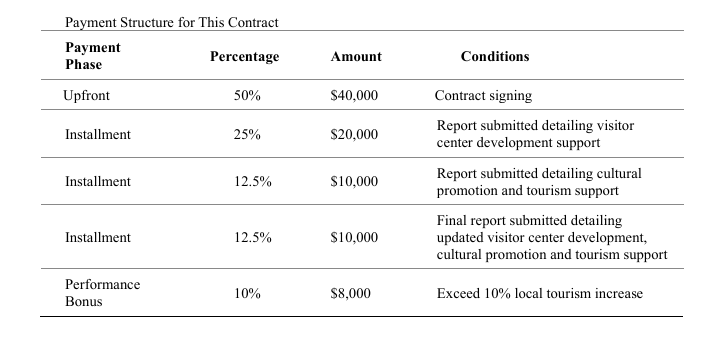
Destination College Park Contract, May 2025
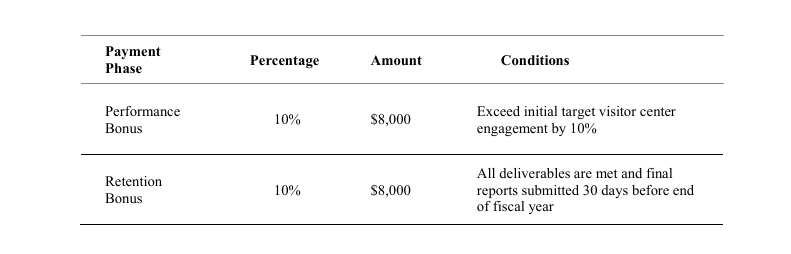
Destination College Park Contract, May 2025
My colleague from Ward 1 said she was responsible: not staff, not the city manager. It was all her.

Workshop Session Transcript, 4/20/2026
I never received an answer about how the performance bonus was paid for exceeding the initial target visitor center engagement by 10%, especially considering we didn’t have a visitor center at time of the contract, and although the Main Street manager was displaced earlier this year so the depot could house a visitor center, it’s still not open.
Now we are on the cusp of selecting a new DMO. That decision coincides with my colleague’s formal request last week to ATL Airport District President Mercedes Miller requiring a detailed accounting of every dollar the District spent that originated from College Park's hotel-motel tax collections, including itemized invoices, transaction ledgers, vendor payment records, advertising expenditures, travel and entertainment, consultant payments, and more.
I think transparency and accountability are paramount. But the timing is curious, especially given the DMO ordinance was on the agenda at our last meeting, and one of the presenters in the workshop session seems to have an understanding that we are partnering with a new DMO. The information my colleague from Ward 1 requested is actually a complete operational blueprint of how a destination marketing organization runs its operation. It is exactly the kind of intelligence a competitor needs to stand up a new organization.
If Destination College Park is selected as the new DMO at the special called meeting scheduled after executive session, two organizations that did not exist this time two years ago, both run by the same person, could be very well-positioned.
CP Historical Preservation Conservancy: MOU up to $2.5 million + $1 million resolution = up to $3.5 million
Destination College Park: previous contract of $104,000 + $1 million to the successor DMO startup if they win
This is a monumental decision. The ATL Airport District has served us well for nearly a decade and a half. If we are not part of that organization, I am deeply concerned that our tourism industry will suffer, and in turn we will have even harder decisions to make as a community.